.png)
Failure Investigation for Gas Turbine - Professional Root Cause Analysis

Updated: Mar 10
Failure Investigation plays a vital role in ensuring reliability, safety, and performance across industries where highly complex machines operate. In critical applications like Gas Turbines, even a minor component failure can lead to major downtime, expensive repairs, and severe safety risks. That’s why industries prefer Failure and Root Cause Analysis to deeply understand why a problem occurred and how it can be prevented in the future.
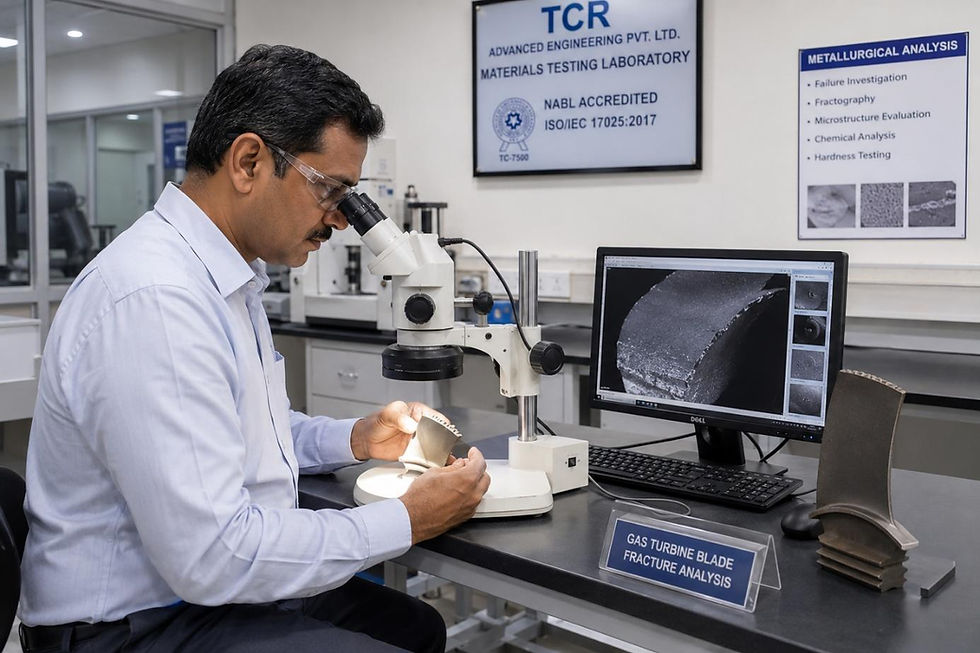
At TCR Advanced Engineering Pvt. Ltd., we specialize in advanced Failure Investigation for Gas Turbines using scientific methods, material testing expertise, and years of engineering knowledge. Our experts carefully examine failed components, mechanical damage, cracks, corrosion patterns, wear issues, and operational history to identify the exact Root Cause. With this approach, we help industries avoid repeated failures, reduce maintenance costs, and improve performance reliability.
TCR’s accurate findings and strong technical approach have made us a trusted partner for gas turbine operators across power, manufacturing, oil & gas, and aerospace sectors.
What is Root Cause Analysis?
Root Cause Analysis is a systematic method used to identify the main reason behind a failure rather than just treating surface-level symptoms. Instead of guessing the cause, engineers use proven investigation techniques, material testing, operational data study, and environmental condition analysis to uncover the true issue.
The purpose of Failure and Root Cause Analysis is to find out what happened, why it happened, and how to stop it from happening again. Root Cause Analysis helps organizations improve reliability, reduce downtime, and enhance safety.
This technique is widely used in mechanical systems, industrial machines, manufacturing lines, oil & gas operations, and turbines. It helps in identifying causes like fatigue, corrosion, overheating, stress, contamination, improper material selection, human error, or incorrect maintenance practices.
With accurate insight, industries can take corrective actions and plan preventive strategies for long-term performance improvement.

Why is Failure Investigation Necessary for Gas Turbine?
Gas Turbines operate under extreme temperature, speed, pressure, and load conditions. Such heavy performance demands make them highly prone to unexpected failures if not monitored and analyzed. When a turbine fails, it can lead to serious consequences including sudden shutdowns, production interruption, safety hazards, and large financial losses.
Failure Investigation becomes essential to understand the exact root cause rather than replacing parts blindly. Without proper analysis, the same problem can happen again and again. Investigation reveals whether the failure occurred due to material fatigue, thermal stress, blade damage, corrosion, creep, wear, poor lubrication, fuel contamination, operational overloading, or manufacturing defects.
Through advanced Failure and Root Cause Analysis, experts provide corrective actions and preventive strategies to increase machine reliability and extend component life.
Failure Investigation prevents catastrophic accidents, improves maintenance decision-making, enhances performance efficiency, and ensures continuous operation.
TCR Advanced Engineering Pvt. Ltd. supports gas turbine operators by providing structured scientific investigation and failure testing services to maintain peak reliability and reduce major risks. For power plants, refineries, aviation systems, and industrial operations, failure investigation is not just beneficial—it is absolutely necessary.
Other Sectors for Failure Investigation
Offshore Structure
Offshore structures such as oil platforms, rigs, and underwater pipelines operate in highly corrosive and extreme environments. They face constant exposure to seawater, pressure variations, mechanical stress, and climate challenges. Failure in these structures can result in massive environmental damage and financial impact. Failure Investigation helps identify structural weaknesses, corrosion causes, fatigue cracks, and weld failures to ensure operational safety. Through accurate analysis, engineers can prevent future breakdowns, extend equipment life, and maintain offshore stability.
Food Processing Equipment
In food manufacturing, equipment reliability and hygiene are extremely critical. Any failure in mixers, conveyors, pressure vessels, or packaging machines can result in production delays and contamination risks. Failure and Root Cause Analysis helps detect issues such as stress cracks, material degradation, corrosion, or improper cleaning processes. By implementing preventive measures, manufacturers ensure safe production, high equipment performance, and compliance with safety standards. Failure investigation supports continuous productivity and quality assurance.
Medical Supplies
Medical equipment such as surgical tools, implants, devices, sterilization equipment, and diagnostic instruments must work with absolute precision. A failure in these products can directly risk patient safety. Failure Investigation identifies defects related to material weakness, wear damage, corrosion, stress fractures, and manufacturing issues. Root cause analysis ensures reliability and regulatory compliance, helping healthcare companies deliver safe and long-lasting products. Strong investigation processes build trust and protect patient lives.
Refineries
Refineries operate with high pressure, temperature, and chemical exposure. Equipment failures such as pipeline leaks, valve damage, corrosion cracking, or pressure vessel rupture can cause shutdowns and massive safety hazards. Failure testing services and scientific analysis help determine the main cause, whether it is stress corrosion cracking, wear, fatigue, contamination, or improper maintenance. Accurate failure analysis ensures stable production, safety improvement, and longer equipment life.
Petrochemical Plants
In petrochemical plants, continuous production and equipment reliability are essential. Machines and components are exposed to aggressive chemicals, high temperatures, and mechanical stress. Failures can lead to fire hazards, system breakdowns, and severe production loss. Root Cause Analysis helps discover the exact reason behind failures and suggests corrective and preventive improvements. This allows industries to avoid repeated problems and maintain smooth operations.
Advantages of Failure Testing Services
1. Prevents Repeated Failures
Failure testing services help organizations understand why a problem occurred so that the same issue does not happen again. Instead of replacing parts without understanding the cause, investigation focuses on identifying the exact technical reason—whether fatigue, corrosion, mechanical over-stress, or environmental impact. Preventing repeat failures improves reliability and extends equipment life. It also ensures safer and more stable operations. Industries save significant repair and maintenance costs through proactive planning and evidence-based decisions.
2. Improves Safety and Reduces Risks
Industrial failures can lead to serious accidents, environmental hazards, or injuries. Proper Failure Investigation helps detect unsafe conditions, hidden damage, and structural weaknesses before they reach a critical stage. By identifying root causes, organizations can implement stronger safety standards and avoid catastrophic breakdowns. With preventive maintenance and safety improvements, workplaces become more secure and compliant with industry regulations.
3. Enhances Productivity and Efficiency
Unexpected machine failures interrupt operations and cause expensive downtime. Failure testing services enable industries to maintain smooth production flow by predicting issues earlier and managing them effectively. With proper maintenance scheduling and improved asset reliability, productivity increases while operational delays reduce. By increasing machine availability and performance reliability, companies achieve better output and business growth.
4. Reduces Cost of Maintenance
When the actual cause of failure is identified correctly, industries avoid unnecessary part replacements, trial-and-error maintenance, and emergency shutdown repairs. Failure analysis provides evidence-based recommendations which help in planning accurate corrective actions. This reduces operational cost, energy loss, and spare part consumption. Over time, smart maintenance greatly lowers the total cost of ownership for machinery and equipment.
5. Supports Better Design and Quality Improvement
Failure Investigation helps manufacturers improve their design, materials, and engineering processes by learning from real performance issues. Data-driven insights allow engineers to upgrade product durability, material selection, joining techniques, and operational guidance. This ultimately delivers stronger, safer, and more reliable equipment for long-term use. Companies build better product quality and stronger customer trust.
Why Leading Industries Trust Us
Leading industries trust TCR Advanced Engineering Pvt. Ltd. because of our scientific expertise, modern testing equipment, and deep understanding of material behavior and industrial engineering. We provide accurate, unbiased, and reliable results backed by advanced laboratories, certified processes, and decades of experience.
Our team includes highly qualified metallurgists, mechanical engineers, and failure analysts who specialize in understanding challenging failures. With a strong track record across power plants, refineries, petrochemical units, aerospace, automotive, and manufacturing industries, we deliver clear recommendations that support safe decisions and long-term solutions.
We follow global investigation standards and use advanced tools such as scanning electron microscopy, metallography, mechanical testing, non-destructive testing, and chemical analysis. Our reports are detailed, easy to understand, and supported by clear evidence and preventive strategies.
Industries trust us because we provide more than just test results — we provide confidence, reliability, and knowledge that protects assets and avoids risk.
Conclusion
Failure Investigation and Failure and Root Cause Analysis are essential for ensuring equipment reliability, performance, and safety. With accurate scientific investigation, industries can avoid repeated breakdowns, improve machine life, enhance safety, and reduce maintenance cost. TCR Advanced Engineering Pvt. Ltd. continues to support industries with world-class expertise, precision testing, and trusted engineering solutions. Our goal is to provide accurate results, actionable recommendations, and long-term value for every client. Reliability begins with understanding the root cause — and we help make that possible.
FAQs
Q1. What is Failure Investigation?
Failure Investigation is the scientific process of studying why a component or machine failed and finding the exact root cause to prevent the problem from recurring.
Q2. Why is Root Cause Analysis important?
It identifies the main reason behind failure, supports evidence-based decisions, and helps improve reliability and safety.
Q3. Which industries need failure testing services?
Power plants, oil & gas, petrochemical, aerospace, manufacturing, medical equipment, food processing, and automotive industries.
Q4. Can failure investigation reduce maintenance costs?
Yes, it helps prevent repeated failures, reduces downtime, and avoids unnecessary repairs.
Q5. Why choose TCR Advanced Engineering Pvt. Ltd.?
Because we deliver accurate analysis, advanced testing, expert investigation, and complete technical support trusted by leading industries.


Comments