Boiler Tube Failure Investigation
3 September 2026
Investigated by the team whose Managing Director wrote the ASM International reference on the subject. Root cause in writing, sister-tube risk answered, restart defended, and the new failure modes of flexible operation read for what they are.
We did not just read the book on boiler tube failure. We wrote it.
Boiler tube failure is a crowded subject. Every laboratory offers an opinion on a burst tube. What separates an opinion from a defensible root cause is the depth of the reference material behind it, and on this subject the reference material carries our Managing Director’s name.
Failure Investigation of Boiler Tubes: A Comprehensive Approach
The Monograph · ASM International, 2018
Authored by Paresh Haribhakti with P.B. Joshi and Rajendra Kumar, published by ASM International, USA. The full taxonomy of waterside, fireside and stress-driven mechanisms, the investigation methodology, and remaining life assessment of boiler tubes, distilled from decades of casework.
Failure of Boiler and Related Equipment
The Handbook Chapter · ASM Handbook Vol. 11A, 2021
Contributed to ASM Handbook Volume 11A, Analysis and Prevention of Component and Equipment Failures, the reference volume failure analysts worldwide reach for first. The same methodology detailed there is the methodology applied to every tube that enters our laboratory in Vadodara.
Flexible operation is rewriting boiler tube failure.
The grid has changed, and the boilers are paying for it. Units designed for decades of steady baseload are now load-following, two-shifting and idling at low load to make room for solar and wind. Flexible operation is the polite name for it. To the pressure parts it means something specific: every start is a thermal transient, every deep load swing is a stress cycle, and every shutdown is a chemistry excursion, on components that were sized for creep life, not fatigue life.
The failure record shifts accordingly. Steady-service boilers fail from long-term overheating, creep and fireside wastage. Cycled boilers fail from thermal fatigue at headers and stub welds, corrosion fatigue at waterwall attachments, dissimilar metal weld distress, condensate quenching damage, off-load corrosion and under-deposit attack fed by start-stop chemistry. A laboratory that investigates a cycled boiler’s tube with a baseload mind-set names the wrong mechanism, and the wrong mechanism buys the wrong fix.
This is where investigation earns its keep in the flexible operation era: the failed tube is the plant’s most honest operating record. Its microstructure grades time at temperature. Its oxide scale back-calculates the metal temperature the records never captured. Its deposits carry the water-chemistry history, and its fracture surface tells you whether the last event was the disease or merely the symptom. Read properly, one tube tells you how the boiler has actually been cycled, which is rarely how the log book says it was.

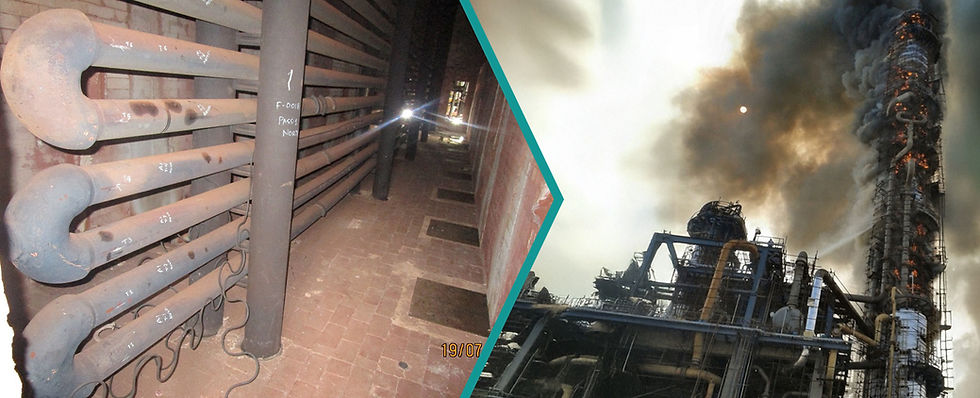
The same boiler, two operating lives. Flexible operation moves the damage from time-dependent mechanisms to cycle-dependent ones, and the investigation approach must move with it.

Every mechanism has a signature. We know all of them.
The monograph organises boiler tube failure into families, each with a distinct metallurgical signature. The laboratory work exists to find that signature, not to guess at it.
Waterside
Hydrogen damage beneath dense deposits
Caustic gouging and under-deposit corrosion
Internal pitting and oxygen attack
Internal scaling driving overheating
Chemistry-excursion damage from cycling starts
Deposit loading · Scale chemistry · DNB history
Fireside
Coal-ash and oil-ash corrosion
Low-temperature dew-point attack
Fly-ash and sootblower erosion
Flame impingement and localised overheating
Off-load and dew-point corrosion during standby
Wastage flats · External scale · Tube thinning maps
Stress & temperature
Short-term overheating: thin-lip burst
Long-term overheating and creep
Thermal fatigue and corrosion fatigue
Dissimilar metal weld (DMW) failure
Graphitisation in ageing carbon steels
Fracture mode · Microstructure grading · Oxide dating
From burst tube to defensible cause.
1. Preserve and documentSampling protocol issued before the tube is cut. As-found photography, position mapping, rupture protected. Evidence first; everything else follows from it. |
2. Fractography and dimensional surveyFracture mode, lip thickness, swelling and wall thinning measured and read against the burst taxonomy: thin-lip violent rupture reads differently from thick-lip creep failure. |
3. Deposit, scale and chemistry analysisInternal deposit loading and composition, external ash chemistry, and oxide scale thickness, the recorder that back-calculates effective metal temperature. |
4. Metallography and microstructure datingSpheroidisation grading, creep cavitation, decarburisation and hydrogen attack assessed against the 1,50,000+ image archive in NABL accredited laboratories (TC-6739). |
5. Mechanism and root causeThe mechanism named per the ASM Volume 11/11A taxonomy and API RP 571, then pushed one level deeper: the operating, chemistry or design condition that set the mechanism running. |
6. Sister-tube risk and the way forwardWhich circuits share the damage, what inspection finds it before it fails, what operating change stops it, and where remaining life assessment under IBR should follow. |
One investigated failure protects every tube still in service.
The cheapest tube failure a plant will ever have is the one that gets investigated properly, because its findings are transferable. The mechanism found in one economiser bend defines the inspection plan for every bend in that bank. The metal temperature read from one superheater tube’s oxide scale recalibrates the remaining life estimate for the whole outlet section. The chemistry history in one deposit rewrites the water-treatment discipline for the unit.
That is how TCR Advanced closes every boiler investigation: not with a report that ends the matter, but with a sister-tube plan that starts the next one properly. Where the plant wants the learning made permanent, the findings feed Remaining Life Assessment of Boilers under IBR, a knowledge-based audit of the unit, and the plant’s damage-mechanism register on AiOM (Asset Integrity Optimization and Management), so the boiler stops re-learning its own failures.
Standards and references applied
ASM Handbook Vol. 11 / 11A
API RP 571
IBR 1950
ASTM E3 · E407 · E112
ASTM A370 · IS 1608
ASME Section I
EPRI cycling damage guidance
Boiler tube failure, answered
Why are boiler tube failures rising under flexible operation?
Units designed for baseload are now load-following, two-shifting and running at low load to balance renewable generation. Every start and deep load swing adds a thermal transient the pressure parts were never designed to absorb daily. The failure record shifts from long-term overheating and creep towards fatigue-led mechanisms: thermal fatigue, corrosion fatigue at waterwall attachments, dissimilar metal weld distress and chemistry-excursion damage during starts and shutdowns.
Can one failed tube really tell the operating history of the boiler?
Yes. The microstructure is a recorder. Carbide spheroidisation grades time at temperature, oxide scale thickness back-calculates effective metal temperature, deposit chemistry records the water-treatment history, and the fracture surface records whether the final failure was ductile, brittle or fatigue driven. Together they reconstruct how the boiler was actually operated.
What should we send for an investigation?
The failed section with the rupture untouched and generous length either side, an adjacent unfailed section from the same circuit for comparison, and the operating context: pressure and temperature records around the event, water chemistry logs, start count and tube position. Ask us for the sampling protocol before cutting; evidence destroyed during removal cannot be recovered.
Which standards and references govern the investigation?
Mechanism identification follows the ASM Handbook Volume 11 and 11A taxonomy and API RP 571; testing runs in NABL accredited laboratories (TC-6739) to ASTM and IS methods; the statutory context follows IBR 1950. TCR Advanced is recognised by the Central Boilers Board as a well-known Remnant Life Assessment organisation and Material Testing Laboratory.
What happens after the root cause is found?
The sister-tube question gets answered: which other tubes carry the same damage and what should be done before they fail. Findings feed RLA of the boiler under IBR, targeted inspection of affected circuits, operating and chemistry recommendations, and the plant’s damage-mechanism register on AiOM where deployed.
Accreditations: ISO/IEC 17025:2017 accredited (NABL TC-6739, TC-13053) · NADCAP Materials Testing AC7101 · CBB / IBR recognised · Recognised Research Institution, MS University.
Your failed tube is trying to tell you something.
Send it to the team that wrote the book on listening. Sampling protocol issued the same day.
.png)


.png)

-2.jpg)



%20as%20per%20API-1104-2.jpg)