Reformer Tube Investigation
4 September 2026
In a steam reformer, every tube is a reactor with its own history. A failed tube is the most honest record of how the furnace was actually run, and, read properly, it is the key to managing the hundreds that remain.
Every tube is a reactor. Treat it like one.
A steam reformer is not one asset. It is several hundred assets standing in rows. Each catalyst-packed tube carries its own share of feed, its own catalyst condition, its own view of the burners around it, and therefore its own metal temperature and its own rate of ageing. Two tubes a metre apart can live entirely different lives. Furnace-average thinking, average tube wall temperature, average growth, average remaining life, is how reformers surprise their owners.
The stakes justify the discipline. Reformer tubes are cast HP micro-alloys running within touching distance of their creep limits by design, and creep life falls exponentially with temperature: a sustained rise of a few tens of degrees in tube metal temperature can halve the remaining life. A hot band from flux imbalance, a patch of degraded catalyst, a trip that quenched a hot tube, each writes itself permanently into the metal. Which is exactly why a failure, painful as it is, is also the single most valuable piece of evidence a reformer owner will ever hold.

One tube, one reactor. Everything the furnace did to it is written into the metal, and the metallurgy can read it back.
How reformer tubes actually fail.
Creep, the design condition
HP micro-alloy tubes operate near their creep limits by design. Life is set by the real temperature history, tube by tube: voids nucleate mid-wall, align, link and become the longitudinal crack the operator finally sees.
Void classification · Larson-Miller logic · Omega method
Overheating events
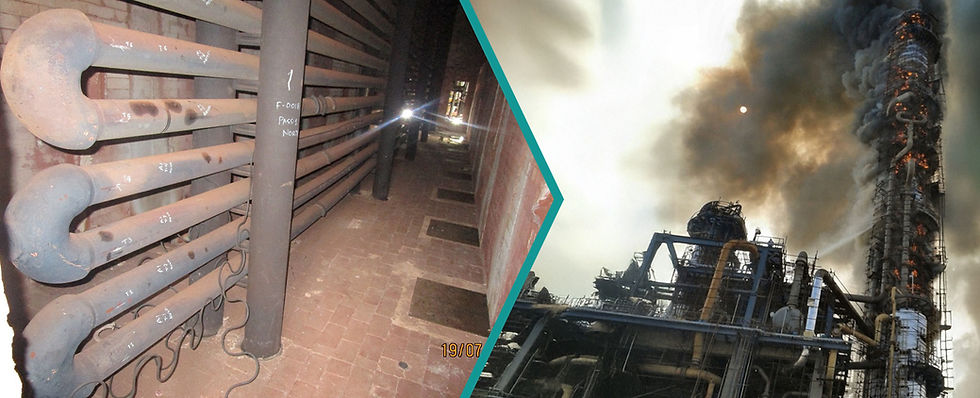
Catalyst degradation, maldistribution or carbon laydown starves a tube of its heat sink; flame impingement and flux imbalance produce hot bands. Short events leave fissured, swollen signatures the microstructure preserves.
Hot bands · Diametral growth · Bowing
Upsets and cycles
Trips and quenches thermal-shock hot tubes; carburisation follows process excursions; inlet and outlet welds and manifolds crack under cycling and stress relaxation. Each upset is written into the record.
DMW & weld cracking · Manifold distress · Trip history
One failed tube, read properly, manages the whole furnace.
This is the part of reformer tube failure most owners never collect on. The investigation of one tube fixes the true relationship between operating history and damage in that specific furnace: how fast this furnace’s tubes actually age, where its hot bands sit, what its trips actually cost. That calibration is worth more than the tube ever was, because every surviving tube can now be screened against it.
The screening is measured, not assumed. The ARTiS integrated inspection approach surveys the fleet tube by tube: diametral growth, wall condition and creep damage. In-situ metallographic replication confirms microstructural state on standing tubes without cutting a sample. Remaining life assessment then ranks every tube: run, watch, or re-tube, with a defensible interval for each. Re-tubing moves from a calendar guess to a condition-ranked capital plan, and the furnace’s damage history becomes a permanent asset on AiOM (Asset Integrity Optimization and Management) rather than a memory that leaves with the engineer who held it.

The fleet learning loop. An investigation is not a post-mortem; it is the calibration of the model that manages every surviving tube.
ARTiS: the reformer tube inspection system built for this loop
TCR Advanced’s integrated approach for remaining life of reformer tubes by NDT combines diametral growth, wall condition and creep damage measurement in a single tube-by-tube survey, feeding the same fleet model the investigation calibrates.

From failed tube to furnace decision.
1. Preserve the evidence
Sampling protocol issued before cutting: rupture protected, orientation and elevation recorded, adjacent material retained, catalyst condition noted.
2. Dimensional and visual survey
Diametral growth mapped along the length, bowing and hot band discolouration recorded, wall thickness profiled: the tube’s external autobiography.
3. Metallography across the wall
Creep void population classified from inner to outer wall, carbide ageing state graded, carburisation depth measured, against the 1,50,000+ image archive in NABL accredited laboratories (TC-6739).
4. Temperature history recovered
Microstructural state converted to effective metal temperature and time, the record the furnace’s pyrometry never captured, hot bands located and dated.
5. Root cause, named
Catalyst event, flux imbalance, trip damage, process excursion or design shortfall, identified and evidenced, with the operating change that prevents recurrence.
6. Fleet decision delivered
The calibrated model applied to the surviving tubes through ARTiS screening and RLA: run, watch or re-tube for every tube, and a re-inspection interval the furnace can defend.
Standards and references applied
API RP 571
API 530
API 579-1 / ASME FFS-1
ASM Handbook Vol. 11 / 11A
ASTM E3 · E407 · E112
Omega / ACRT creep method
In-situ metallographic replication
Reformer tubes, answered
Why is every reformer tube called a reactor?
Because it is one. Each catalyst-packed tube carries its own share of feed, its own catalyst condition, its own flux from the burners around it and its own metal temperature. Two tubes a metre apart can live entirely different lives. Furnace-average thinking fails for reformers; integrity has to be managed tube by tube.
What can one failed tube reveal about furnace operation?
Almost everything the log sheets did not capture. Creep voids date and locate the overheating, carbide ageing grades time at temperature, carburisation depth records process upsets, bowing and diametral growth record hot bands and flux imbalance, and weld cracking records trip history. Together they reconstruct how that section of the furnace was actually fired.
How does one investigation help manage the tubes still in service?
It calibrates the fleet model. Once the failed tube fixes the true relationship between operating history and damage in that furnace, the surviving tubes are screened against it with ARTiS integrated NDT and in-situ metallography, and remaining life assessment ranks every tube: run, watch or re-tube, each with a defensible interval.
How sensitive is reformer tube life to metal temperature?
Extremely. Creep life falls exponentially with temperature, so a modest sustained rise in tube metal temperature, of the order of tens of degrees, can cut remaining creep life by half or more. That is why hot bands and catalyst maldistribution matter so much, and why recovering the true temperature history from the microstructure is worth more than averaged pyrometry.
When should a tube be re-tubed rather than run?
When measured condition says so, not when the calendar does. Tubes with advanced aligned creep voids, significant diametral growth or deep carburisation are re-tube candidates; tubes with benign microstructure can run past nominal design life with a defined re-inspection interval. The investigation and fleet screening together make that call defensible.
Accreditations: ISO/IEC 17025:2017 accredited (NABL TC-6739, TC-13053) · NADCAP Materials Testing AC7101 · Recognised Research Institution, MS University.
The furnace already wrote its history. Let us read it.
One investigated tube is the cheapest furnace model you will ever buy. Sampling protocol issued the same day.
.png)


.png)

-2.jpg)



%20as%20per%20API-1104-2.jpg)