Fire Damage Assessment
12 September 2025
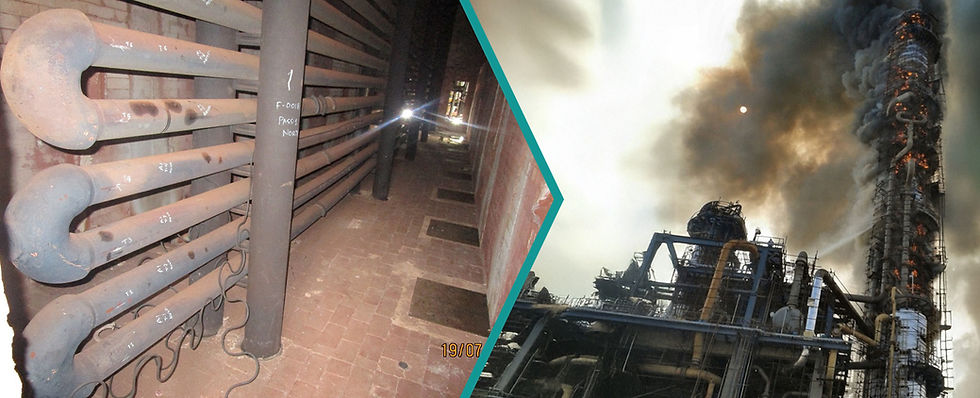
Fire Damage Assessment is a detailed engineering evaluation carried out to determine the impact of fire exposure on industrial equipment, structures, and materials. Fire incidents can significantly alter material properties, structural integrity, and load-bearing capacity, even when visible damage appears limited. This service provides a clear understanding of whether fire-exposed assets can be safely returned to service, repaired, or require replacement.
The assessment applies to metallic and non-metallic components affected by direct flame impingement, radiant heat, or elevated temperatures during fire events. It supports informed decisions related to plant restart, repair planning, insurance claims, and regulatory compliance.
Why Fire Damage Assessment Is Required
After a fire incident, the extent of damage is often not fully visible. Fire Damage Assessment helps address challenges such as:
Uncertainty about loss of mechanical strength in fire-exposed materials
Hidden metallurgical degradation due to high temperature exposure
Structural deformation or loss of load-carrying capacity
Safety risks during restart without proper evaluation
Disputes related to insurance and liability
Decision-making on repair versus replacement
A structured assessment ensures safety is not compromised by assumptions.
Scope of Assessment
Fire Damage Assessment typically covers:
Pressure vessels, piping, and storage tanks
Structural steel members and supports
Boilers, heaters, and heat-affected components
Equipment foundations and supports
Non-metallic components such as seals, gaskets, linings, and composites
The scope is defined based on fire severity, exposure duration, and asset criticality.
Assessment Methodology
The assessment follows a systematic engineering approach.
Review of fire incident details, temperature exposure, duration, and affected zones.
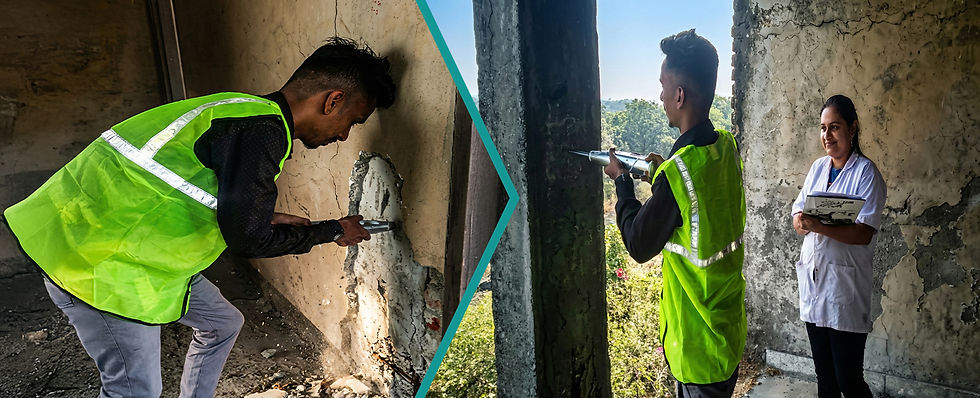
Visual inspection to identify distortion, discoloration, scaling, cracking, or surface damage.
Non-destructive testing to assess material integrity, hardness variation, and internal defects.
Metallurgical evaluation to identify microstructural changes, loss of strength, or phase transformation.
Structural and mechanical assessment to evaluate residual strength and load-bearing capacity.
Classification of damage severity and determination of repairability.
Recommendations covering repair, replacement, inspection intervals, and safe re-commissioning.
Tools, Techniques and Standards
Fire Damage Assessment is supported by:
Hardness testing and metallurgical examination
Non-destructive testing methods
Dimensional and alignment checks
Engineering calculations and material property evaluation
Assessments align with applicable ASTM, ASME, API, and structural engineering standards.
Key Benefits
Clear understanding of fire-induced damage
Safe and informed restart decisions
Reduced risk of secondary failures
Optimized repair and replacement planning
Technical support for insurance claims
Improved plant safety and reliability
Industries and Applications
This service is applied across oil and gas facilities, refineries, petrochemical plants, power plants, chemical units, storage terminals, manufacturing facilities, and infrastructure projects.
Applications include post-fire evaluation of equipment, piping systems, structures, and storage installations.
Fire Damage Assessment provides an engineering-based evaluation of fire-affected assets, ensuring safety and reliability are restored before re-commissioning. By identifying hidden damage and residual strength, this service supports informed decision-making after fire incidents.


.png)
.png)

-2.jpg)


%20as%20per%20API-1104-2.jpg)