Remaining Life Assessment of FRP/GRP Tanks
12 September 2025
Remaining Life Assessment of FRP and GRP Tanks is a systematic evaluation carried out to determine the structural integrity, material condition, and safe remaining service life of fibre-reinforced plastic storage tanks. FRP and GRP tanks are widely used for storage of corrosive chemicals due to their corrosion resistance, but their long-term performance depends heavily on material quality, fabrication practices, and service conditions.
This service helps plant owners understand the current health of ageing FRP and GRP tanks and supports decisions related to continued operation, repair, rehabilitation, or replacement. Remaining life assessment is particularly critical where tanks are operating beyond their original design life or under conditions different from those originally intended.
Why Remaining Life Assessment Is Required
FRP and GRP tanks degrade over time due to environmental exposure and service conditions. Remaining Life Assessment helps address challenges such as:
Operation of tanks beyond their design life
Uncertainty regarding structural integrity and safety
Chemical attack leading to resin degradation
UV exposure causing surface ageing and loss of strength
Delamination, cracking, or blistering of laminate layers
Changes in operating temperature or stored media
Regulatory and safety compliance requirements
Without proper assessment, deterioration may remain undetected until leakage or structural failure occurs.
Scope of Assessment
Remaining Life Assessment of FRP and GRP tanks typically includes:
Storage tanks for chemicals, acids, alkalis, and effluents
Process tanks and reaction vessels
FRP/GRP linings and laminate structures
Tank nozzles, supports, and connections
Each assessment is tailored based on tank geometry, material system, service media, and operating history.
Assessment Methodology
The assessment follows a structured and condition-based approach.
Review of design drawings, fabrication details, material specifications, operating conditions, and inspection history.
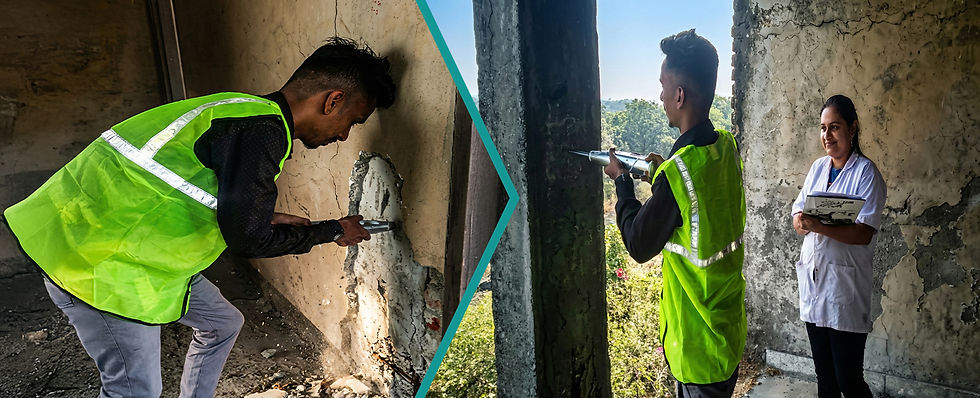
Visual inspection to identify surface damage, cracking, blistering, resin degradation, and signs of leakage.
Non-destructive evaluation techniques such as thickness measurement, hardness testing, and acoustic or tap testing to assess laminate condition.
Material evaluation to assess fibre orientation, resin condition, degree of curing, and signs of chemical attack.
Structural evaluation to assess load-bearing capacity, support conditions, and deformation.
Remaining life estimation based on observed degradation, material properties, and service exposure.
Recommendations covering repair methods, rehabilitation options, inspection intervals, and life extension feasibility.
Tools, Techniques and Standards
Remaining Life Assessment of FRP and GRP tanks is supported by:
Visual and close-up inspection techniques
Laminate thickness measurement
Hardness and surface property evaluation
Material and resin compatibility assessment
Structural integrity evaluation
Assessments are aligned with applicable international standards, industry guidelines, and good engineering practices for composite structures.
Key Benefits
Clear understanding of current tank condition
Early detection of degradation and failure risks
Improved safety and environmental protection
Optimized repair or replacement planning
Extended service life where technically feasible
Compliance with safety and regulatory requirements
Industries and Applications
This service is widely applied in chemical plants, petrochemical facilities, fertilizer units, refineries, water and effluent treatment plants, and process industries using FRP or GRP storage systems.
Applications include storage tanks, process vessels, scrubbers, and lined equipment handling corrosive media.
Remaining Life Assessment of FRP and GRP Tanks provides a factual understanding of structural and material health. By identifying degradation mechanisms and estimating remaining service life, this service supports safe operation, informed decision-making, and effective asset management.


.png)
.png)

-2.jpg)



%20as%20per%20API-1104-2.jpg)