Remaining Life Assessment of Process Plant Components
12 September 2025
Remaining Life Assessment (RLA) of Process Plant Components is an engineering evaluation carried out to determine the safe remaining service life of equipment that has been in operation for a significant period. The objective is to assess current condition, identify active damage mechanisms, and estimate how long the component can continue to operate safely under existing or modified conditions.
This service is essential for ageing plants operating beyond their original design life, where replacement may not be immediately feasible or economically viable. RLA supports informed decisions related to continued operation, repair, refurbishment, replacement, and life extension.
The assessment covers critical static and rotating equipment such as pressure vessels, heat exchangers, reactors, columns, piping systems, storage tanks, and associated components operating under high temperature, pressure, and corrosive environments.
Why Remaining Life Assessment Is Required
Process plant components degrade over time due to a combination of mechanical loading, thermal exposure, corrosion, erosion, and operational upsets. RLA helps address challenges such as:
Operation of equipment beyond original design life
Increasing frequency of leaks, failures, or shutdowns
Lack of clarity on actual health of critical assets
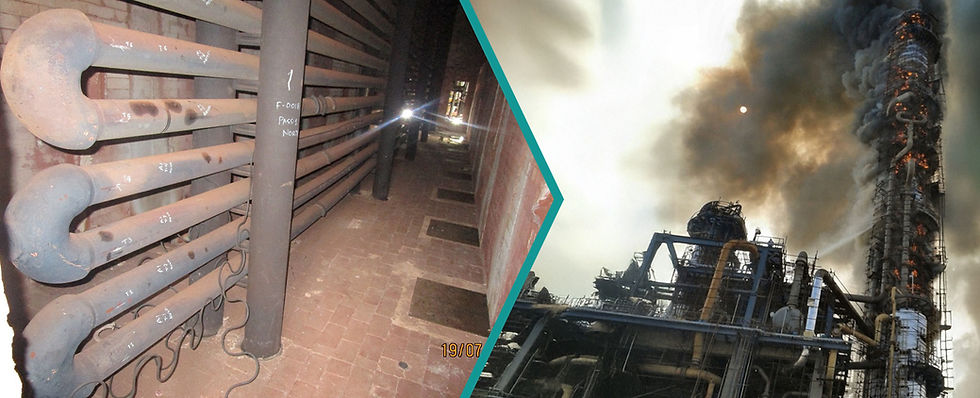
Risk of catastrophic failure due to undetected damage
Regulatory and statutory compliance requirements
Planning of turnarounds, replacements, or revamp projects
Optimization of maintenance and inspection strategies
Without RLA, decisions are often based on assumptions rather than actual equipment condition.
Scope of Assessment
Remaining Life Assessment of process plant components typically includes:
Pressure vessels and columns
Heat exchangers and reactors
Process piping and headers
Storage tanks and associated nozzles
High-temperature and high-pressure components
Each assessment is customized based on equipment criticality, service conditions, and operating history.
Assessment Methodology
Remaining Life Assessment is conducted using a systematic and condition-based approach.
Data collection and review includes design data, material specifications, operating parameters, inspection history, maintenance records, and previous failure data.
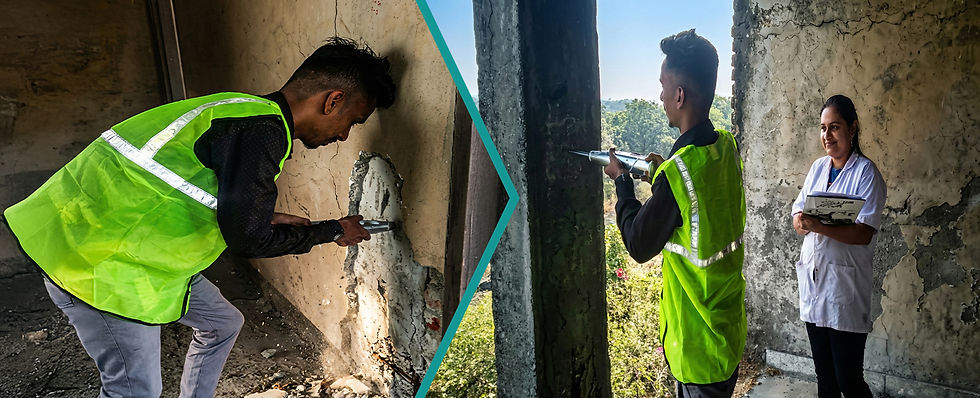
On-site inspection involves visual examination, dimensional checks, and advanced non-destructive testing to detect wall thinning, cracking, corrosion, and other forms of degradation.
Metallurgical evaluation includes in-situ metallography, hardness testing, and laboratory examination where required to assess microstructural degradation.
Damage mechanism identification focuses on corrosion, erosion, fatigue, creep, stress corrosion cracking, hydrogen-related damage, and metallurgical ageing.
Engineering analysis evaluates stress levels, operating loads, temperature exposure, and remaining corrosion allowance to estimate remaining life.
Life estimation and recommendations include safe operating life, inspection intervals, repair options, replacement planning, and life extension strategies.
Tools, Techniques and Standards
Remaining Life Assessment is supported by advanced inspection and analytical tools, including:
Advanced ultrasonic and thickness measurement techniques
In-situ metallography and hardness testing
Corrosion mapping and damage-specific NDT
Engineering calculations and life assessment models
Assessments are aligned with applicable ASTM, ASME, API, IBR, and international engineering guidelines.
Key Benefits
Accurate estimation of remaining safe service life
Prevention of unexpected failures and shutdowns
Improved asset reliability and safety
Optimized maintenance and inspection planning
Support for life extension and revamp decisions
Compliance with regulatory and statutory requirements
Industries and Applications
This service is widely applied across oil and gas, refineries, petrochemical plants, fertilizer units, chemical processing facilities, power plants, EPC projects, and heavy engineering industries.
Applications include assessment of ageing vessels, piping systems, heat exchangers, and critical plant equipment operating under severe service conditions.
Remaining Life Assessment of Process Plant Components provides a factual and engineering-based understanding of equipment health. By identifying active damage mechanisms and estimating remaining service life, this service enables safe operation, cost-effective maintenance, and informed long-term planning.


.png)
.png)
-2.jpg)



%20as%20per%20API-1104-2.jpg)