.png)
The Boiler Tube Keeps Failing: What Root Cause Analysis Finds


A boiler tube ruptures on a Tuesday afternoon. The unit trips, the maintenance crew isolates the leaking section, welds in a replacement, and by the weekend the plant is back at load. Six weeks later, the same boiler goes down again. Different tube, same bank, same story. This is usually the point where operators start asking the wrong question. They ask which tube failed. The question that actually stops the next outage is why this boiler keeps producing failures in the first place. A proper Failure and Root Cause Analysis helps shift the focus from the failed tube to the underlying problem driving these recurring failures.
That question is what a proper Failure and Root Cause Analysis is built to answer. A caustic gouge on a waterwall tube or a fireside crack on a superheater loop is almost never an isolated event. It's usually the visible end of a chain that started somewhere else, in water chemistry that drifted out of spec, a flow restriction nobody caught during the last outage, or a startup ramp rate pushed harder than the metal could take. Replace the tube without tracing that chain and you've bought yourself a few months, not a fix.
Why the Third Failure Is Never Bad Luck
Every operator has heard some version of "it's just an old boiler." That explanation gets more expensive every time it's repeated. A forced outage on a mid-sized thermal unit can cost lakhs of rupees per hour once you count lost generation, restart fuel, and penalty clauses. And that's before anyone talks about the safety exposure of a high-pressure steam release, or the awkward conversation with an insurer who wants to know why the same failure mode showed up twice in one financial year.
A repaired tube without an investigated cause is a scheduled failure, just with the date left blank.
Unplanned outage cost: restart fuel, lost generation, and contractual penalties stack up fast on a repeat trip.
Safety exposure: a tube rupture at operating pressure is a high-energy event, not a maintenance inconvenience.
Insurance and warranty scrutiny: recurring failures without a documented root cause weaken your position in any claim.
Cumulative metallurgical damage: creep, fatigue, and hydrogen damage don't reset when you weld in a new spool piece.
Waterside Damage: What the Water Is Doing to the Tube From Inside
Failures that originate inside the tube trace back to chemistry, deposits, or internal stress. Six mechanisms account for most of what we see in the lab.
Mechanism | Where It Shows Up | What's Driving It |
Caustic Attack | Furnace wall & inclined tubes | High-pH deposits breaking down the protective magnetite layer; poor circulation |
Oxygen Pitting | waterwall tubes, economizers | Dissolved oxygen from air in-leakage or improper layup during outages |
Hydrogen Damage | Waterwall tubes, high heat flux zones | Low-pH excursions combined with under-deposit corrosion |
Acid Attack | Waterwall tubes | Poor chemical cleaning and inadequate post-cleaning neutralisation |
Stress Corrosion Cracking | Stainless steel superheater/reheater tubes | Tensile stress plus steam carryover or chemical residue |
Corrosion Fatigue | Tube attachments, welds, supports | Start-stop cycling combined with fluctuating water chemistry |
Hydrogen damage deserves particular attention because it's the one mechanism that gives almost no warning. Low-pH excursions combined with under-deposit corrosion release atomic hydrogen that migrates into the tube wall, and the metal looses ductility from the inside out. By the time you see intergranular cracking on the surface, the tube has usually already lost the margin that would have let it bulge or leak before it ruptured.
Fireside Damage: What's Happening Outside the Tube
Fireside failures come from the flame side, not the water side, and they tend to look completely different under a microscope.
Mechanism | Where It Shows Up | What's Driving It |
Fuel Ash Corrosion | Superheaters and reheaters | Molten coal or oil ash reacting with tube material at high temperature |
High-Temperature Oxidation | High-temperature superheater zones | Surface temperature exceeding the material's oxidation limit |
Waterwall Fireside Corrosion | Lower furnace waterwall tubes | Reducing atmosphere from poor combustion or staged firing |
Fireside Fatigue | Furnace wall tubes, superheater, reheater | Thermal fatigue from cyclic temperature swings. Corrosion fatigue due to the layers of hot corrosion |
Erosion | Waterwall, Economizers, superheaters, reheaters | Fly ash or sootblowing steam impingement |
Mechanical Fatigue | Tube penetrations, welds, supports | Cyclic vibration from flue gas flow, sootblowers, or cycling |
Fireside fatigue has a signature that experienced inspectors learn to spot from a distance: an "elephant hide" or "alligator hide" texture on the tube's outer surface, caused by circumferential cracking from repeated thermal cycling. It's one of the few failure modes you can flag visually before it becomes a leak, if someone knows to look for it during a shutdown inspection.
The Failures That Don't Look Like Corrosion At All
Not every boiler tube failure is a chemistry problem. Some of the most damaging ones are mechanical or metallurgical, and they get missed precisely because nobody's looking for pitting or scale.
Short-Term and Long-Term Overheat
A short-term overheat produces a ductile, "fish mouth" rupture, usually from blocked flow during startup. A long-term overheat looks nothing like it: narrow longitudinal splits and heavy external scaling, the result of creep after months or years of running hotter than the design intended. The two are easy to tell apart under a microscope. They're almost impossible to tell apart from a plant log.
Graphitization and Dissimilar Metal Weld Failures
Carbon and carbon-molybdenum steels exposed to long-term high temperature, particularly in weld heat-affected zones, can degrade through graphitization, leaving a brittle, thick-edge fracture. Dissimilar metal welds at superheater and reheater outlet header connections fail differently again: thermal expansion mismatch between austenitic and ferritic metals builds stress at the fusion line until it lets go, often with almost no warning. Low ductility creep mechanism also can prevail at the ferritic side HAZ regions.
"Most boiler tube failures don't happen overnight," says Paresh Haribhakti, Managing Director of TCR Advanced Engineering. "They develop through progressive damage mechanisms that leave metallurgical fingerprints, if someone knows where to look."
What a Structured Failure Investigation Actually Involves

A root-cause investigation isn't a longer version of a visual inspection. It's a structured sequence that connects a specific damage mechanism to a specific operating condition, and it usually needs more than one discipline in the room.

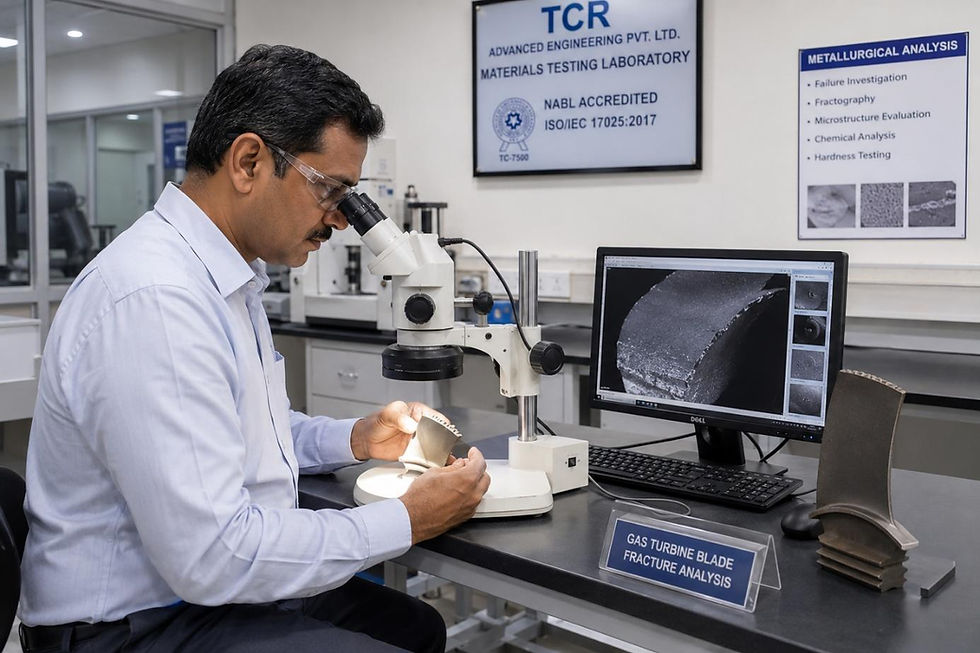
Fractography under SEM tells you how the crack initiated and propagated. In-situ metallography tells you what the microstructure looked like at the moment of failure, without cutting out a full section where that isn't practical. And none of it means much without cross-checking against the boiler's actual operating history, water chemistry logs, and any recent changes in fuel or firing pattern. Skip that last step and you're left with an accurate description of the failure and no idea what caused it.
Getting the Root Cause Right the First Time
The tube that failed is rarely the whole story. Waterside, fireside, or purely mechanical, most boiler tube failures are downstream symptoms of a condition that will keep producing failures until someone traces it back and fixes it at the source. Regular monitoring, disciplined water chemistry control, and correct startup and shutdown procedures prevent a lot of these mechanisms from ever getting started. But once a failure has occurred, treating it as a corrective event rather than a proactive one is where the real cost gets locked in.
A structured Failure and Root Cause Analysis isn't an extra step after a boiler trip. It's the difference between paying for a weld and paying for the same weld again in six weeks.
At TCR Advanced Engineering, our team of metallurgical and asset integrity specialists has supported over 1,800 clients across power, refinery, petrochemical, fertilizer, and manufacturing sectors. With 10,000+ failure investigations behind us and 500+ years of cumulative team expertise, we bring the technical depth and field experience to trace a boiler tube failure to its actual root cause, not just its symptom. Reach out to our team or learn more about our Failure Investigation and Asset Integrity Management services at www.tcradvanced.com. |
Frequently Asked Questions
Q: What's the real difference between a waterside and a fireside boiler tube failure?
A: Waterside failures start with what's happening inside the tube, chemistry, deposits, or dissolved oxygen attacking the internal wall. Fireside failures start outside, from combustion gases, ash, or flame impingement. They often look completely different under a microscope, which is why the first step in any investigation is establishing which side of the tube the damage actually originated on.
Q: If the failed section was already cut out and replaced, can a root cause still be established?
A: It's harder, but not impossible. A retained failed sample gives the clearest answer through fractography and metallography. Without it, TCR can still reconstruct the root cause from water chemistry logs, operating history, and damage patterns on adjacent tubes in the same bank, though the confidence level depends on how much evidence survived the repair.
Q: Can a boiler tube fail from more than one mechanism at the same time?
A: Yes, and it's more common than operators expect. Corrosion fatigue, for instance, is a corrosive environment combined with cyclic stress acting together. Separating which mechanism initiated the damage and which one accelerated it is exactly the kind of distinction a structured investigation is built to make.
Q: How long does a full failure and root cause investigation typically take?
A: It depends on the mechanism and how much operating history is available, but a straightforward case with a clean sample and complete water chemistry records can be turned around in days. Cases needing extended metallurgical work or deeper log reconstruction take longer.
Q: What can a plant do before the investigation team arrives to protect the evidence?
A: Preserve the failed section without further cutting or cleaning, photograph the failure in place before removal, and pull the water chemistry and operating logs for the weeks leading up to the failure. The fracture surface degrades quickly once exposed, so the sooner it's protected, the more the investigation can tell you.


Comments