.png)
Why Accurate Failure and Root Cause Analysis Matters for Industrial Success

Updated: Mar 10
At TCR Advanced Engineering PVT. LTD., we specialize in delivering world-class Failure and Root Cause Analysis services across India. Over the years, we have built a strong reputation for providing accurate, reliable, and timely solutions to complex equipment and material failures. Every industrial setup faces challenges related to unexpected failures, whether in machinery, pipelines, turbines, or boilers. Understanding the root cause of these failures is crucial for preventing recurrence, ensuring safety, and improving operational efficiency. Our team of experts combines deep industry knowledge with advanced technology to offer comprehensive failure analysis and failure testing services tailored to the unique needs of each client.
We believe that effective Root Cause Analysis is not just about identifying what went wrong but also understanding why it happened. By delivering detailed insights and actionable recommendations, we help industries maintain uninterrupted operations, reduce downtime, and improve overall safety and performance. Our services are trusted by clients across diverse sectors, from heavy machinery and manufacturing to petrochemicals and aerospace. Every Failure Investigation Report prepared by our team provides clear findings and practical solutions, ensuring that our clients can implement preventive measures with confidence.
What is Failure and Root Cause Analysis
Failure and Root Cause Analysis is a systematic process of investigating equipment, material, or process failures to determine their underlying causes. Failure and Root Cause Analysis is the process of uncovering the fundamental cause of a failure and using that insight to develop effective corrective or preventive strategies. While a simple failure analysis may identify what component failed, Root Cause Analysis digs deeper to understand the conditions and factors that led to the failure. This distinction is critical because addressing only the immediate cause without understanding the root cause often leads to repeated failures, increased maintenance costs, and operational inefficiencies.
Root cause investigations can include visual inspections, metallurgical studies, chemical analysis, mechanical testing, and stress analysis, among other techniques. The goal is to identify fundamental deficiencies, whether related to material defects, design flaws, operational errors, or environmental factors. By capitalizing on technological advances and structured methodologies, TCR Advanced ensures that each Failure Investigation Report provides an accurate, actionable, and scientifically backed explanation of the failure.
Failure investigations can cover a wide range of scenarios, from sudden equipment breakdowns to gradual degradation over time. Our approach emphasizes not only technical accuracy but also clear communication with stakeholders, ensuring that clients can understand the findings and implement preventive measures effectively.

Why Choose Us
TCR Advanced Engineering PVT. LTD. stands out as a trusted provider of Failure and Root Cause Analysis due to its deep expertise, sectoral knowledge, and extensive track record. We have successfully completed over 1800 failure investigation assignments, earning the trust of clients across India and abroad. Our experience spans multiple industries and includes major projects in manufacturing and metallurgical failures related to ASME boilers, pressure vessels, gas turbine engine components, oil and gas transmission pipelines, food processing equipment, heat exchangers, medical supplies, refineries, petrochemical plants, aircraft and aerospace components, offshore structures, industrial machinery, weldments, and ships.
Choosing TCR Advanced means partnering with a team that understands the unique challenges of each sector. Our experts apply best practices, combine field experience with laboratory analysis, and deliver failure analysis and failure testing services that are precise, reliable, and actionable. Every we produce is detailed, clear, and designed to support informed decision-making. Our mission is to help clients reduce downtime, prevent recurring failures, improve safety, and optimize equipment performance.
Different Types of Failure Investigations Conducted by Us
TCR Advanced Engineering PVT. LTD. conducts comprehensive investigations for a wide range of failures, ensuring that all potential causes are thoroughly analyzed. Some of the major failure investigations we conduct include: Boiler Tube Failure Investigation: Boiler tubes are critical in steam generation and power production. Failure in these tubes can result from corrosion, overheating, or material defects. Our team investigates the root cause, enabling clients to implement corrective measures and prevent recurrence.
Shaft Failure Investigation: Shafts are essential components in rotating machinery. Failures may occur due to fatigue, misalignment, improper lubrication, or metallurgical defects. Our in-depth investigations identify the primary cause and recommend design or operational improvements.
Heater Tube Failure Investigation:Heater tubes in furnaces and industrial heaters are exposed to extreme temperatures and corrosive environments. We conduct precise failure analysis to identify causes such as thermal fatigue, scaling, or material defects.
Heat Exchanger Inspection:Heat exchangers are vital in many industrial processes. Failures can result from corrosion, erosion, fouling, or thermal stress. Our inspections and testing services help ensure that heat exchangers operate efficiently and safely.
Reformer Tube Failure Investigation:Reformer tubes are integral in petrochemical and refinery operations, especially in hydrogen and ammonia production. Tube failures can disrupt production and compromise safety. Our investigations focus on identifying material, operational, or design-related causes.
Failure Investigation of Steam Turbine: Steam turbines are critical in power generation, and failures can lead to significant downtime and economic loss. We conduct thorough investigations to identify mechanical, metallurgical, and operational causes.
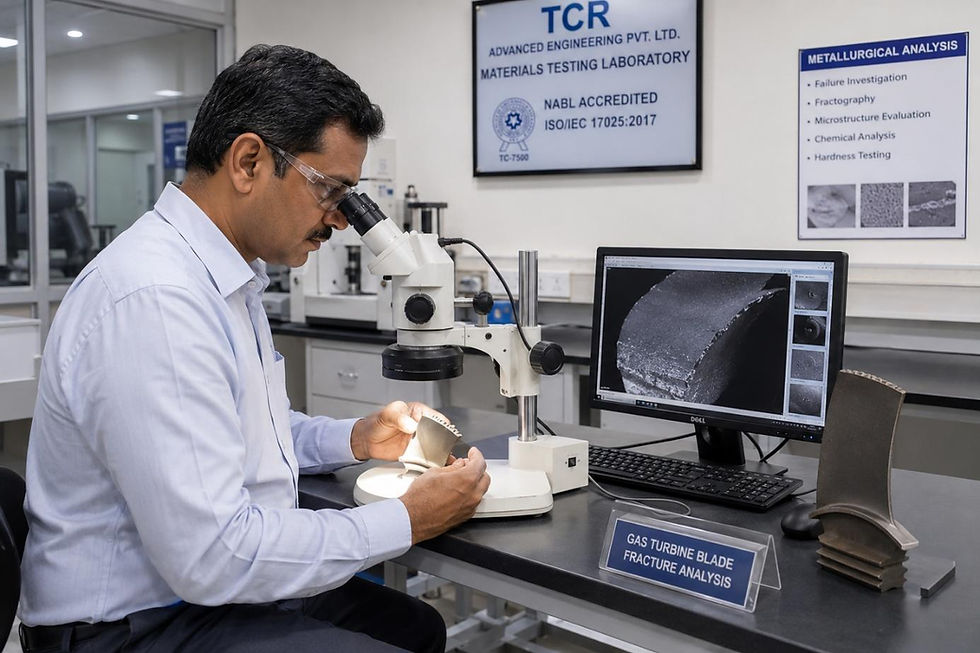
Failure Investigation of Gas Turbine: Gas turbines operate under high temperatures and rotational speeds. Our expert team identifies causes of blade, shaft, or housing failures, providing actionable solutions for improved turbine reliability.
Failure Investigation of Boiler Tube: Reiterating our expertise, we handle boiler tube failures with a combination of metallurgical analysis, stress testing, and operational evaluation to produce comprehensive Failure Investigation Reports.
Through these investigations, TCR Advanced ensures that clients receive not just the cause of failure but also practical recommendations to prevent future incidents, optimize performance, and enhance operational safety.
Types of Equipment Used by TCR for Root Cause Analysis
To perform accurate Root Cause Analysis, TCR Advanced Engineering PVT. LTD. employs state-of-the-art equipment and testing methodologies. Some of the key instruments and tools used in our investigations include: Metallurgical Optical Microscope with Image Analysis System: Allows detailed examination of microstructures, identifying material defects, cracks, and phase changes.
Scanning Electron Microscope with EDAX: Provides high-resolution imaging and elemental analysis to understand material composition and microstructural anomalies.
Stress Analyzer: Measures residual and applied stresses in components to identify fatigue or overstress as potential failure causes.
Complete Mechanical and Chemical Testing Equipment: Enables evaluation of hardness, tensile strength, chemical composition, corrosion resistance, and other critical material properties.
Dilatometer: Used for thermal expansion testing, helping assess the behavior of materials under temperature variations.
Equipment for Metallographic Sample Preparation: This includes diamond saw cutters, mounting presses, rough grinders, belt polishers, wheel or disc polishers, electrolytic etcher polishers, and microscopes with attachments for micro-hardness testing. These tools ensure high-quality sample preparation for accurate analysis.
Micro Hardness Tester: Determines the hardness of specific areas, essential for identifying weaknesses or localized damage that could lead to failure.
By combining these advanced tools with expert analysis, TCR Advanced provides precise failure analysis and robust Root Cause Analysis for a wide range of industries and equipment types.
Industries We Serve for Failure and Root Cause Analysis in India
Our services cater to industries that rely on high-performance equipment and materials, where failures can result in significant operational or economic losses. Some of the key sectors we serve include:
Thermal Power Plants: Boiler tubes, turbines, and heat exchangers are critical in power generation. Our investigations help prevent downtime and ensure safe operations.
Heavy Machinery & Manufacturing: Shafts, weldments, and mechanical components are analyzed to enhance reliability and productivity.
Petrochemical Plants: Reformer tubes, heaters, and pipelines require precise failure analysis to prevent costly operational disruptions.
HVAC & Refrigeration: Heat exchanger failures and corrosion issues are addressed through meticulous failure testing services.
Petrochemical & Refinery (Hydrogen and Ammonia Production): Reformer tubes, pipelines, and pressure vessels are investigated to ensure safety, efficiency, and compliance.
Gas-Fired Power Plants: Gas turbine failures are analyzed to improve operational reliability and prevent unplanned outages.
By serving such a diverse range of industries, TCR Advanced demonstrates its ability to adapt techniques, methodologies, and Root Cause Analysis approaches to the specific requirements of each sector.
Conclusion
TCR Advanced Engineering PVT. LTD. stands at the forefront of Failure and Root Cause Analysis in India. Our combination of extensive field experience, advanced testing equipment, and a deep understanding of industry best practices ensures that every failure investigation report we deliver is precise, actionable, and tailored to the client’s needs. Whether it’s a boiler tube, turbine shaft, heat exchanger, or complex metallurgical failure, our team is equipped to identify the root cause and provide recommendations that prevent recurrence.
Partnering with TCR Advanced means investing in reliability, safety, and operational efficiency. Our failure testing services and investigations are designed to empower industries to maintain uninterrupted operations, reduce costs, and improve performance across the board. By choosing us, clients gain access to a trusted partner with a proven track record of over 1800 successful failure investigations across multiple sectors in India.
FAQs
1. What is Failure and Root Cause Analysis?
Failure and Root Cause Analysis is the process of investigating the underlying reasons for equipment or material failures, identifying both immediate and fundamental causes, and providing recommendations to prevent recurrence.
2. Why is Root Cause Analysis important?
Root Cause Analysis goes beyond identifying what failed. It ensures that the underlying issues are addressed to prevent future failures, reduce downtime, and enhance safety and reliability.
3. What types of failures can TCR Advanced investigate?
We conduct investigations for boiler tubes, shafts, heater tubes, heat exchangers, reformer tubes, steam turbines, gas turbines, and other critical equipment.
4. Which industries do you serve?
Our services cater to thermal power plants, heavy machinery & manufacturing, petrochemical plants, HVAC & refrigeration, refineries, gas-fired power plants, and other industrial sectors.
5. What kind of equipment do you use for failure analysis?
We use advanced equipment, including metallurgical microscopes, scanning electron microscopes with EDAX, stress analyzers, mechanical and chemical testing equipment, dilatometers, and micro-hardness testers.
6. Do you provide actionable recommendations?
Yes. Every Failure Investigation Report includes detailed findings and practical recommendations to prevent future failures and improve operational efficiency.


Comments