.png)
When the Test Report Is Not Enough: What a Material Characterization and Testing Laboratory Actually Delivers

A supplier submits a material test certificate and everything looks acceptable on paper. The heat number matches, the tensile values fall within range, and the hardness numbers check out. Then the component cracks in service after six weeks.
This scenario plays out more often than most quality engineers would like to admit. A certificate of conformance is not the same as actual material characterization. The numbers on a mill certificate tell you what the material was declared to be at the point of manufacture. A proper material characterization and testing laboratory tells you what it actually is — including everything the certificate does not cover.
The distinction matters. In industries where a single component failure can trigger an unplanned shutdown, a safety incident, a regulatory finding, or an insurance dispute, the quality of material intelligence is directly proportional to the quality of decisions made downstream. Selecting the right laboratory is not a procurement decision. It is an engineering decision.
What Material Characterization Actually Involves
Material characterization is the systematic determination of a material's composition, microstructure, and physical and mechanical properties. It goes well beyond running a tensile test and reading the numbers. True characterization requires understanding how the material's internal structure relates to its performance behaviour under real service conditions.
In practice, this means combining several analytical disciplines:
Chemical composition analysis by Optical Emission Spectrometry (OES) to verify alloy identity, check for trace element deviations, and confirm compliance with material specifications such as ASTM, IS, DIN, or EN standards.
Microstructural examination by optical metallography and Scanning Electron Microscopy (SEM) to assess grain structure, phase distribution, inclusion content, and any anomalies introduced during manufacturing or heat treatment.
Mechanical property evaluation covering tensile strength, yield strength, elongation, hardness, and impact toughness — the parameters that determine how a material performs when loaded in service.
Physical and surface property assessment including surface roughness, dimensional verification, and in some cases texture analysis for materials whose surface condition directly affects performance.
Corrosion behaviour testing to evaluate how a material responds to its operating environment — including intergranular corrosion susceptibility, stress corrosion cracking resistance, and static immersion behaviour per ASTM G31.
Material characterization is not a test. It is a complete technical picture of what a material is and how it will behave — built from multiple analytical inputs. |
Each of these disciplines contributes a different layer of understanding. Missing any one of them can leave critical gaps in the material intelligence that engineers and procurement teams rely on.
The Role of NABL Accreditation in Material Testing
Not all material testing is equal. A test result is only as credible as the system behind it — the calibration of the equipment, the training of the operator, the validity of the test method, and the rigour of the quality management system governing the entire process.
NABL accreditation under ISO/IEC 17025 is the internationally recognised standard for technical competence in testing and calibration laboratories. A material testing laboratory accredited by NABL has demonstrated, through independent assessment, that it meets specific requirements for:
Personnel competence and defined responsibilities across all testing activities
Equipment calibration traceability to national and international measurement standards
Documented test methods that conform to the referenced standard (ASTM, IS, EN, DIN, or others)
Measurement uncertainty quantification for each test type
Internal quality audits, proficiency testing participation, and systematic corrective action processes
For industries operating under regulatory oversight — oil and gas, pharmaceutical, power, aerospace, and statutory inspection frameworks — NABL accreditation is not optional. Test results from a non-accredited laboratory may not be accepted by clients, insurers, or regulatory bodies. In some procurement situations, a material certificate from a non-accredited source carries no contractual weight at all.
TCR Advanced Engineering's laboratory holds NABL accreditation (ISO/IEC 17025) for both chemical and mechanical testing. Every result issued by this laboratory is technically defensible.

Testing Across Material Classes and Industry Standards
A laboratory that claims to serve industry broadly must be capable of testing across diverse material classes and configuring test protocols to match the relevant national or international standard. TCR Advanced's material testing capability spans metals and alloys, polymers and plastics, composites, and non-metallic materials including elastomers and engineered materials used in consumer goods.
Metals and Alloys
The majority of structural and pressure-retaining components in heavy industry are fabricated from carbon steel, alloy steel, stainless steel, and nickel-based alloys. Metal and alloy material testing services cover the full set of mechanical tests required for material qualification and ongoing quality surveillance: tensile testing per ASTM A370 or IS 1608, Charpy impact testing per ASTM A370 / ASTM E23, Brinell and Vickers hardness, bend and re-bend tests, and weld procedure qualification testing per AWS D1.1 or ASME Section IX. Chemical verification by OES confirms alloy identity and guards against material substitution — a surprisingly common issue in complex supply chains.
Polymers and Plastics
Polymer and plastic testing demands a different set of protocols. Materials testing under tension and compression for polymer grades follows ASTM D638 for tensile properties, ASTM D790 for flexural strength, and ASTM D695 for compressive behaviour. Stress-strain curve generation is standard output for these tests, providing the full deformation response rather than a single data point. For products where surface texture and force-displacement response are the defining performance characteristics, texture analyser-based testing captures the behaviour that conventional mechanical tests do not measure.
Physical and Mechanical Properties — Force and Distance Measurement
Materials testing for force and distance measurement covers the load-displacement behaviour of materials and components under controlled conditions. This includes pull testing, push-out testing, and load vs. displacement curve generation — methods used extensively in fastener qualification, adhesive bond assessment, and structural joint evaluation. The precision of force measurement and displacement tracking in these tests directly determines the reliability of the data.
Table 1: Material Testing by Sector — Key Tests and Governing Standards
Sector | Key Tests Performed | Governing Standards |
Oil & Gas / Petrochemical | Tensile, Charpy Impact, Hardness, Corrosion, PMI, OES | ASTM A370, ASTM G31, NACE MR0175, ASTM E23, IS1500 |
Power Generation | Creep Testing, High-Temp Tensile, Metallography, SEM | ASTM E139,ASTM E21, ASTM E92, IS 1608, EN 10002 |
Pharmaceutical / Medical | Biocompatibility, Chemical Composition, Surface Analysis | ISO 10993, ASTM F136, IS 15760 etc… |
Manufacturing / Fabrication | Tensile, Bend, Re-bend, Hardness, Weld Qualification | ASTM A370, AWS D1.1, IS 2062, DIN EN 10025 , ASTM E8, ASME SEC IX Etc.. |
Polymers / Consumer Goods | Tensile, Compression, Flexural, Stress-Strain, Texture | ASTM D638, ASTM D790, ISO 178, IS 7328 etc.. |
Material Testing for Product Development and R&D
Material testing is not only a quality assurance function. In product development and research contexts, it is the primary tool for generating the data that determines whether a new material, formulation, or design is fit for purpose.
For R&D applications, the testing requirement is often more flexible and exploratory than for production conformance. Teams need to understand how a material behaves across a range of conditions rather than simply confirming it meets a single specification point. This means generating full stress-strain curves, mapping property variation across specimen locations, evaluating the effect of surface treatment or heat treatment on mechanical response, and comparing candidate materials head-to-head on relevant performance parameters.
TCR Advanced's laboratory supports product development and R&D testing across material classes. For polymer and composite development, this means generating the full mechanical data set. For metallic alloy development or incoming material evaluation, this means combining chemical analysis with microstructural assessment and mechanical testing. For consumer goods material testing, it means evaluating how materials used in packaging, household products, or medical devices perform under the loading conditions they will actually experience in use.
The output from R&D testing is only useful if the data analysis and reporting is done rigorously. Raw test data presented without context, statistical evaluation, or traceability to the test method is not meaningful engineering intelligence. TCR Advanced's materials testing data analysis and reporting practice converts test outputs into documented, traceable, and actionable findings.
Regulatory Compliance and Cross-Standard Testing
Industries operating across national and international markets face a complex landscape of material testing standards. A petrochemical plant in India may be designed to ASME and ASTM standards. Its equipment may be supplied by a European fabricator working to EN standards. The client's insurer may require test reports referencing specific IS standards for domestic regulatory compliance. The laboratory serving this client must be able to work fluently across all of these frameworks simultaneously.
Material testing services as per ASTM, IS, DIN, and EN standards covers the full range of mechanical and chemical tests that international procurement and regulatory frameworks require. Key standard families include:
ASTM A370, ASTM E8/E8M, ASTM E23 for mechanical testing of metallic materials
IS 1608, IS 1757, IS 5242 for Indian national standard mechanical testing
DIN EN 10002, EN 10045 for European standard tensile and impact testing
ASTM G31, ASTM G36, ASTM A262 for corrosion testing of metals and alloys
ASTM D638, D790, D695 for polymers and plastics
ISO 10993, ASTM F136 for medical device material compliance
For material testing in the oil and gas industry specifically, compliance with NACE MR0175 / ISO 15156 for sulphide stress cracking resistance is often mandatory for materials in sour service. These tests require specific specimen preparation, controlled test environments, and rigorous result interpretation — the kind of specialised capability that most general-purpose laboratories cannot offer credibly.
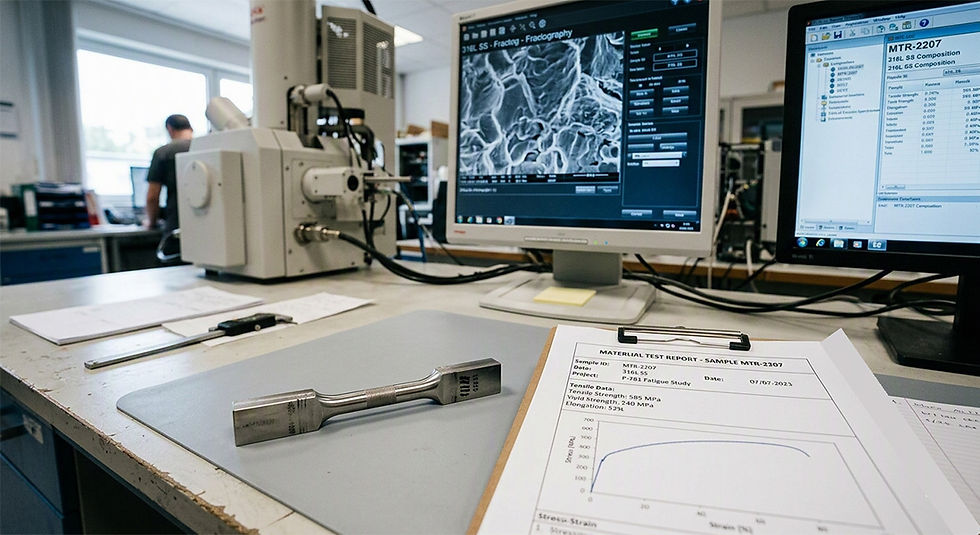
How Raw Material and Finished Product Testing Prevents Costly Failures
One of the most economically significant applications of material characterisation and testing is incoming material verification. Across Indian industry, material substitution — intentional or otherwise — remains a genuine risk. A structural steel supplied as Grade 250 may not conform to the specified yield strength. A stainless steel pipe certified as 316L may carry a chromium or molybdenum content outside specification. A polymer component declared as meeting UV resistance requirements may fail prematurely in outdoor service.
Materials testing for raw materials and finished products provides the early warning system that supply chain audits cannot. A chemical composition check by OES, combined with a hardness survey and a tensile test, takes hours. The cost of not performing it can be months of unplanned downtime.
For finished products, end-of-process testing confirms that the manufacturing process has not degraded the material properties established at the raw material stage. Welding, heat treatment, forming, and machining all have the potential to alter mechanical properties, introduce residual stresses, or create microstructural anomalies. Testing at the finished product stage catches these issues before the product reaches service.
For industries supplying to regulated sectors — pharmaceutical packaging, food contact materials, medical devices, or safety-critical structural applications — finished product material testing is not optional. It is the documented evidence that the material meets the specification and the regulatory requirement simultaneously.
Materials Testing for Electrical and Electronics Products
Electronic and electrical products impose a distinct set of material performance requirements. The materials used in circuit board substrates, connector housings, cable insulation, encapsulant compounds, and structural components must perform across thermal cycling, mechanical vibration, chemical exposure, and long service life conditions — often simultaneously.
Material testing for electrical and electronics products covers dielectric properties, thermal stability, mechanical performance under environmental cycling, and chemical resistance of polymer and composite materials. Surface analysis by SEM-EDS is commonly applied to identify contamination, verify coating composition, and investigate delamination or corrosion failures at the material interface.
For component manufacturers supplying to the automotive electronics or industrial controls market, material test data is frequently required as part of product qualification documentation. TCR Advanced's accredited laboratory generates the defensible test data that these qualification packages require.
The Material Intelligence That Decisions Depend On
The organisations that manage material risk well share a common practice: they invest in understanding their materials before those materials go into service, not after something goes wrong. A material characterization and testing laboratory is the instrument through which that understanding is built.
Good material intelligence reduces procurement risk by catching non-conforming materials at the incoming stage. It supports engineering decisions during design and product development by providing accurate property data rather than estimates or assumptions. It provides the documented evidence that regulatory compliance requires. And when something does fail in service, it provides the forensic foundation that root cause analysis depends on.
The test report is the starting point, not the destination. What matters is the quality of the laboratory behind it, the rigour of the methodology applied to each test, and the expertise of the team interpreting and reporting the results. Across all of these dimensions, the choice of material testing laboratory is a more consequential engineering decision than it usually receives credit for.
At TCR Advanced Engineering, our NABL-accredited material characterization and testing laboratory has served over 1,800 clients across oil and gas, petrochemical, power, fertilizer, pharmaceutical, and manufacturing sectors. Backed by 9,500+ investigations and 500+ years of cumulative team expertise, we bring the depth and precision that industrial material decisions demand — whether you need raw material verification, failure investigation support, R&D testing, or regulatory compliance documentation. Reach our team or explore our full material testing capabilities at www.tcradvanced.com. |
Frequently Asked Questions
Q1. What is a material characterization and testing laboratory and how is it different from a basic testing lab?
A material characterization and testing laboratory combines chemical composition analysis, microstructural examination, mechanical property testing, and corrosion evaluation to build a complete picture of a material's identity and performance capability. A basic testing lab typically performs one or two test types in isolation. Characterisation requires multiple analytical disciplines applied together and interpreted by experienced materials engineers.
Q2. Why does NABL accreditation matter for material testing in industrial procurement?
NABL accreditation under ISO/IEC 17025 confirms that the laboratory's testing methods, equipment calibration, personnel competence, and quality management system have been independently assessed and validated. In regulated industries, test reports from non-accredited laboratories may not be accepted by clients, regulatory bodies, or insurers. NABL-accredited results carry technical and legal defensibility that non-accredited results do not.
Q3. Which materials can TCR Advanced's laboratory characterise and test?
TCR Advanced's laboratory tests carbon steels, alloy steels, stainless steels, nickel alloys, aluminium alloys, copper alloys, polymers and plastics, composites, elastomers, and non-metallic materials including packaging and consumer goods materials. Testing protocols are configured to match the relevant ASTM, IS, EN, or DIN standard for each material class and application.
Q4. What is materials testing for stress-strain measurement and when is it required?
Stress-strain testing generates the full mechanical response curve of a material from elastic deformation through yield and into plastic deformation and fracture. It is required for material qualification in structural and pressure equipment design, for R&D work where material selection depends on comparing deformation behaviour, and for polymer and plastic materials where the full stress-strain curve is more informative than a single tensile strength value.
Q5. Does TCR Advanced test materials to international standards for oil and gas applications?
Yes. TCR Advanced's laboratory performs material testing as per ASTM A370, ASTM G31, NACE MR0175 / ISO 15156, API 5L, and related standards applicable to oil and gas material qualification. This includes sour service corrosion testing, tensile and impact testing for pressure vessel and pipeline materials, and chemical composition verification by OES.
Q6. How does materials testing data analysis and reporting improve on a standard test report?
Standard test reports present numerical results with a pass or fail outcome. TCR Advanced's data analysis and reporting practice adds engineering interpretation — identifying which results are close to specification limits and warrant attention, explaining what out-of-specification findings mean for material performance, flagging trends across a batch of test specimens, and presenting findings in a format that supports direct engineering decision-making rather than requiring further interpretation by the client.


Comments