.png)
When the Spectrometer Contradicts the Certificate: What a Chemical Testing Laboratory Actually Does for Industrial Materials

A batch of stainless steel pipes arrives at a fabrication yard. The mill certificates look clean. The heat numbers check out. The supplier's test report shows chromium and nickel content within the 316L specification. But something in the weld keeps failing.
The investigation eventually finds sulphur and phosphorus levels that are within the specification on paper but sitting right at the upper limit. When combined with the actual welding conditions on site, those borderline trace levels are enough to trigger hot cracking in the heat-affected zone. The certificate didn't lie. It just didn't tell the full story.
This is exactly the gap that a properly equipped chemical testing laboratory exists to close. Not just confirming grade identity, but building the complete elemental picture of a material in a way that predicts how it will actually behave. The difference between those two things can be the difference between a weld that holds and one that doesn't.

What Chemical Analysis of Industrial Materials Really Involves
Chemical composition is not a single number. A material's full elemental profile, including major constituents, minor alloying elements, and trace impurities, collectively determines its mechanical properties, corrosion resistance, weldability, and long-term service behaviour. Getting the complete picture requires more than one technique.
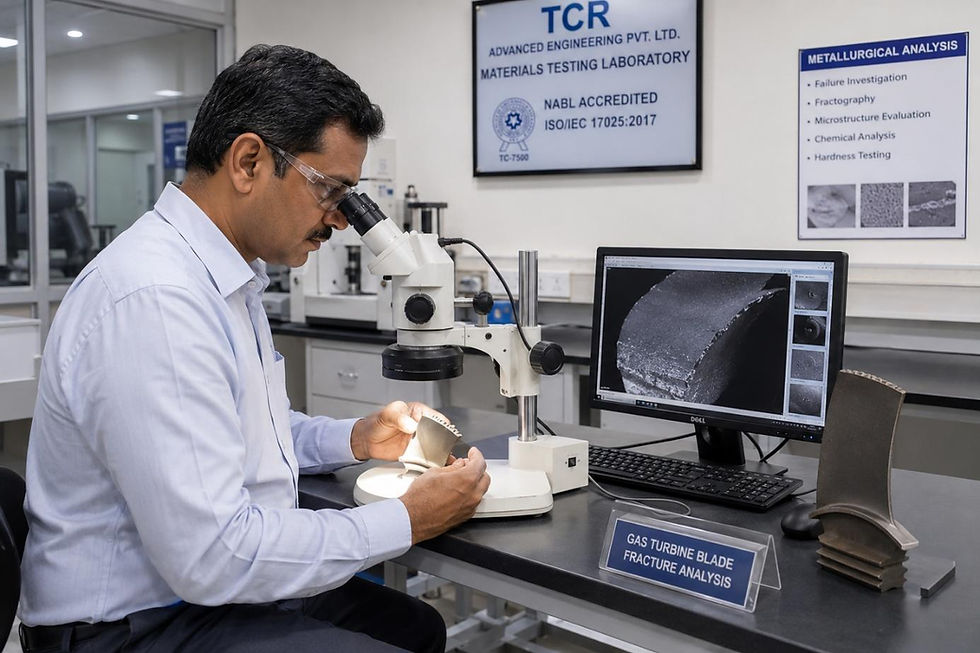
At TCR Advanced's ISO 17025-accredited lab uses OES, ICP-OES, XRF, and wet chemistry to deliver chemical analysis that predicts how industrial materials actually behave.
Optical Emission Spectrometry (OES) for Metal Analysis
OES is the workhorse of metal composition testing. A spark is generated between an electrode and the sample surface, exciting the atoms in the material. The light emitted is analysed to identify and quantify the elements present. It's fast, accurate for bulk composition, and covers the full elemental range relevant to carbon steels, alloy steels, stainless steels, nickel alloys, aluminium alloys, copper alloys, and more.
What OES does particularly well is rapid grade verification. When a batch of material arrives and needs confirmation that it matches the specified grade, OES delivers the answer in minutes. For production environments where throughput matters, that speed is critical. TCR Advanced uses OES routinely for positive material identification (PMI), incoming material verification, and chemical testing for metals and alloys analysis per ASTM E415, E1086, and E1999.
ICP-OES for Trace Elements Detection
Inductively Coupled Plasma Optical Emission Spectrometry works differently. The sample is dissolved in acid and introduced as an aerosol into a high-temperature plasma. This approach allows detection of elements parts per billion for many elements" or "sub-ppm to ppb range.". That's the domain of ICP-OES chemical analysis services for trace elements detection.
Why does trace-level analysis matter in practice? Because certain elements exert significant influence at very low concentrations. Hydrogen in steel causes embrittlement. Phosphorus at elevated levels causes temper embrittlement in alloy steels. Lead contamination in a food-contact polymer triggers a compliance failure. Arsenic and antimony in refinery feedstocks accelerate catalyst poisoning. These aren't hypothetical scenarios. They're the kind of findings that drive plant shutdowns and product recalls. ICP-OES is how you find them before they find you.
XRF for Non-Destructive Composition Testing
X-Ray Fluorescence is the method of choice when the sample can't be consumed or when on-site analysis is required. XRF analysis services for metal composition testing are commonly used in two situations: sorting mixed material stockpiles where identity has been lost, and verifying installed components in-service where destructive sampling isn't feasible.
Portable XRF also plays an important role in plant inspection. When a turnaround team needs to confirm that valve bodies or flange materials match the P&ID specifications, a handheld XRF unit covers large numbers of components quickly. The results aren't as granular as OES for certain elements, particularly carbon in steel, but for major and minor alloying elements XRF is reliable and fast.
Wet Chemistry for Specific Element Validation
Some determinations still rely on classical wet chemistry methods, particularly for carbon, sulphur, and phosphorus in steel where method-specific accuracy is required by the governing standard. Wet chemistry testing services for material composition analysis per IS 228 or ASTM E350 provide element-specific results with well-established uncertainty characteristics. These methods are often used to validate OES results on critical applications or to satisfy specific contract requirements that name a particular test method.
The technique matters as much as the result. Choosing the wrong method for the material and the element of interest produces data that looks credible but isn't actionable. |
Table 1: Chemical Analysis Techniques for Industrial Materials
Technique | Best For | Detection Range | Destructive? | Common Standards |
OES (Optical Emission Spectrometry) | Bulk metal/alloy composition, PMI, grade verification | Major to minor elements (ppm range) | Minimal surface prep only | ASTM E415, E1086 |
ICP-OES | Trace and ultra-trace elemental analysis, liquids and digested solids | ppb to ppm range | Yes (sample digestion) | ASTM D5185, EPA 200.7 |
XRF (X-Ray Fluorescence) | Non-destructive alloy sorting, coating thickness, on-site PMI | Major to minor elements | No (fully non-destructive) | ASTM E1268, ISO 14596, ASTM E1476 |
Wet Chemistry | Specific element validation, sulphur, carbon, phosphorus in steels | Defined by method | Yes | IS 228, ASTM E350, E354 |
SEM-EDS | Surface deposit ID, failure investigation, corrosion product analysis | Elemental mapping, point analysis | Sample prep required | ASTM E1508 |
Why ISO 17025 Accreditation Changes the Value of a Test Report
Not every laboratory that runs an OES test is producing results with the same level of credibility. NABL accreditation under ISO/IEC 17025 is the mechanism through which a laboratory demonstrates that its testing is technically sound, its equipment is properly calibrated, its personnel are competent, and its quality management system is functioning. It's independent verification, not self-certification.
For procurement teams, this matters because a test report from an ISO 17025 certified chemical testing laboratory carries weight that a non-accredited report does not. Regulatory bodies, insurance surveyors, and client quality functions in the oil and gas and petrochemical sectors routinely require accredited test reports as a condition of material acceptance. In legal or insurance disputes arising from component failures, the accreditation status of the testing laboratory is one of the first things reviewed.
TCR Advanced's laboratory holds NABL accreditation (ISO/IEC 17025) for both chemical and mechanical testing. Every chemical test report issued is technically defensible, traceable to calibration standards, and supported by a documented quality management system.
Beyond accreditation, the laboratory's integration with TCR's failure investigation capability means chemical analysis results don't sit in isolation. When a client sends a failed component for investigation, the chemical testing output feeds directly into the root cause analysis. That connection between chemical data and engineering interpretation is what turns a number into an actionable finding.
Where Chemical Testing Delivers the Most Operational Value
Oil and Gas and Petrochemical Sectors
Material testing services for the oil and gas industry cover the full spectrum from incoming pipe and fitting verification through to in-service component analysis. In sour service environments governed by NACE MR0175 / ISO 15156, chemical composition directly determines whether a material is acceptable for use. Nickel content limits in carbon steels, hardness and heat treatment requirements for alloy steels, and sulphide stress cracking resistance all tie back to chemical specification compliance. Chemical analysis is step one.
In refineries, trace metals analysis laboratory services are used for process-side applications too. Catalyst contamination, process fluid composition, and corrosion product identification all involve chemical analysis that goes beyond standard alloy verification.
Power Generation
Boiler and pressure vessel materials operate under conditions where small deviations in alloy chemistry can drive creep damage acceleration or contribute to stress corrosion cracking over long service lives. In-service replica testing and metallographic analysis of power plant components are frequently supported by chemical composition verification to confirm whether the material in the field matches the specified grade. Quantitative elemental analysis for industrial materials in this sector often reveals gradual contamination or depletion of protective alloying elements that only spectroscopic analysis can identify.
Manufacturing and Fabrication
Incoming material verification is the single highest-value application of chemical analysis services for manufacturing industries. When a fabrication shop receives a heat of steel plate, verifying composition before it goes into a welded assembly takes a few minutes and costs a fraction of the rework bill that results from discovering a composition problem after the fact.
Chemical purity and impurity analysis is also used in fabrication for weld consumable verification, confirming that flux, filler wire, or electrode chemistry meets the welding procedure specification. Contaminants in consumables are a common and underappreciated root cause of weld defects.
Polymers, Plastics, and Non-metallic Materials
Polymer and plastics chemical testing services address a different set of analytical questions. Chemical structure identification using FTIR (Fourier Transform Infrared Spectroscopy) confirms polymer type and detects adulterants or degradation products. Elemental analysis services for organic and inorganic samples identify additive content, filler composition, and contamination in polymer matrices. For pharmaceutical packaging, food-contact materials, and medical device components, this level of chemical characterisation is a regulatory requirement.
Chemical composition analysis for unknown substances, including recovered fragments from failed components, contaminated samples, or unidentified materials, is a specialist capability that TCR Advanced's laboratory provides for failure analysis testing services for metals and polymers.
Failure Investigation and Chemical Analysis: How They Connect
Chemical analysis and failure investigation are not separate service lines at TCR Advanced. They're integrated disciplines. When a component fails, the chemical testing function doesn't just confirm grade identity. It investigates what the chemistry tells us about why the component failed.
Typical chemical findings in failure investigations include:
Sulphur or phosphorus above specification in a cracked steel component, pointing to material non-conformance as a contributing factor.
Chloride deposits at a stress corrosion cracking initiation site, identified by SEM-EDS, confirming the corrosive agent and its source.
Hydrogen content measurement in a brittle fracture specimen, supporting a hydrogen embrittlement diagnosis.
Carbon and alloy element depletion in a carburised or decarburised surface layer, explaining premature fatigue crack initiation.
Unexpected elemental peaks in a corrosion deposit, pointing to process-side contamination that accelerated the attack.
In each case, the chemical data is not a standalone output. It's evidence that feeds the engineering conclusion. That's the difference between a chemical testing laboratory that generates reports and one that generates insight.
"We see this pattern repeatedly, says Paresh Haribhakti, Managing Director, TCR Advanced Engineering. "A material passes the incoming test but fails in service. The incoming test confirmed grade compliance. What it didn't check was the trace element profile. When we look at the failed component, the answer is already in the chemistry."

Chemical Structure Identification for Unknown and Complex Materials
Not every sample that arrives at a testing laboratory comes with a known identity. Mixed material stockpiles, recovered fragments from equipment failures, samples of suspected contamination, and unidentified coatings or deposits all require chemical structure identification and analysis services rather than standard composition verification.
TCR Advanced's laboratory handles these cases using a combination of techniques. SEM-EDS provides elemental mapping of surface deposits. FTIR identifies polymer type and functional group chemistry. OES or XRF confirms metallic composition. When multiple techniques are applied to the same sample, the combined output is far more informative than any single analysis.
For industrial clients dealing with suspected material substitution, where a component that should be one alloy is suspected to be another, this multi-technique approach is the most reliable way to reach a definitive conclusion. The same approach applies to chemical composition analysis for unknown substances found in process streams, corrosion products, or residues from equipment failures.
The Data Behind Every Material Decision.
Every decision about whether a material is suitable for a given application ultimately rests on chemical data. The grade specification, the weld procedure qualification, the corrosion resistance claim, the fitness for service assessment — all of these trace back to chemical composition somewhere in the chain.
What changes when that chemical data comes from a properly equipped, ISO 17025-accredited laboratory is the confidence level of the decisions downstream. A composition result from a calibrated OES system, verified by wet chemistry where the standard requires it, and reported under an accredited quality management system, is a different class of information from a mill certificate or a non-accredited lab result.
The organisations that manage material risk well understand this distinction. They don't treat chemical testing as a box-ticking exercise. They treat it as the intelligence that informs procurement decisions, weld procedure development, corrosion management, and failure prevention. That shift in perspective is what separates reactive problem-solving from proactive asset integrity management. And it starts with getting the chemistry right.
At TCR Advanced Engineering, our NABL-accredited (ISO/IEC 17025) chemical testing laboratory has served over 1,800 clients across oil and gas, petrochemical, power, fertilizer, pharmaceutical, and manufacturing sectors. With 9,500+ failure investigations completed and 500+ years of cumulative team expertise, our chemical analysis services go well beyond a number on a report. We interpret what the data means for your material, your process, and your risk. To discuss a testing requirement or learn more about our laboratory capabilities, visit www.tcradvanced.com. |
Frequently Asked Questions
Q1. What is optical emission spectrometry (OES) testing and when is it used?
OES uses a high-energy spark to excite atoms in a metal sample. The characteristic light emitted by each element is measured to identify and quantify all elements present. It's the standard method for rapid, accurate bulk composition analysis of metals and alloys. TCR Advanced uses OES for incoming material verification, PMI, grade confirmation, and weld consumable analysis per ASTM E415, E1086, and E1999.
Q2. What is the difference between OES and ICP-OES?
OES analyses solid metal samples directly and is best for bulk elemental composition at major to minor element concentrations. ICP-OES digests the sample into solution and analyses it in a plasma torch, enabling detection at parts-per-billion levels. ICP-OES is the method of choice when ultra-trace elemental detection is required, such as checking phosphorus or arsenic at very low concentrations, or analysing liquid process samples and digested solids.
Q3. Is XRF analysis as accurate as OES for metal composition testing?
XRF is reliable for major and minor alloying elements and has the significant advantage of being non-destructive, making it suitable for on-site PMI and in-service component verification. But for carbon in steel, XRF is generally less accurate than OES because carbon is a light element that XRF has limited sensitivity to measure at the concentrations relevant to steel grades. For applications where carbon content is critical, OES or wet chemistry remains the preferred method.
Q4. Why does NABL accreditation matter for chemical test reports?
NABL accreditation under ISO/IEC 17025 confirms that the laboratory's test methods, equipment calibration, personnel qualifications, and quality management system have been independently assessed and validated. In regulated industries and high-stakes procurement, test reports from non-accredited laboratories may not be accepted by clients, regulatory bodies, or insurance surveyors. Accredited results carry technical and legal defensibility that non-accredited results cannot match.
Q5. What types of materials does TCR Advanced's chemical testing laboratory handle?
TCR Advanced's laboratory tests carbon steels, alloy steels, stainless steels, nickel alloys, aluminium alloys, copper alloys, cast irons, and other metallic materials. Non-metallic testing covers polymers and plastics (chemical structure identification by FTIR, elemental analysis), corrosion deposits and process residues (SEM-EDS), and unknown substance identification. Both raw materials and finished or failed components are accepted.
Q6. Can chemical testing support a failure investigation?
Yes, and at TCR Advanced it routinely does. Chemical analysis is an integral part of the failure investigation methodology. Composition verification confirms whether the material met specification. Trace element analysis identifies impurities that may have contributed to failure. SEM-EDS analysis of fracture surfaces and corrosion deposits identifies the corrosive agents and contaminants present at the failure site. The chemical findings feed directly into the root cause conclusion.
Q7. What is wet chemistry testing and when is it still used over instrumental methods?
Wet chemistry involves dissolving a material sample and using volumetric or gravimetric chemical reactions to determine specific element concentrations. It's used when a governing standard specifies it, when results from instrumental methods need independent validation for critical applications, or when the element being measured is better suited to a classical method. Sulphur and phosphorus determination in steels per IS 228 and carbon determination per ASTM E350 are common examples where wet chemistry remains the reference method.
Q8. How quickly can TCR Advanced turn around chemical test results?
Standard OES composition results are typically available within 24 to 48 hours of sample receipt. ICP-OES trace analysis and wet chemistry testing have slightly longer turnaround due to sample preparation requirements, generally 48 to 72 hours. Urgent requirements can be discussed directly with the laboratory team. Fast turnaround does not compromise the accuracy or traceability of results under TCR's accredited quality management system.


Comments