.png)
Failure Investigation Techniques for the Power Generation Industry

Updated: Sep 11
The power generation industry is the backbone of global energy supply. High temperatures, high pressures, and continuous operation make these systems vulnerable to unexpected failures. In this high-stakes environment, downtime can mean millions in losses, while safety incidents can have devastating consequences. This is where Failure Investigation becomes crucial. By identifying the root cause of equipment breakdowns, industries not only restore functionality but also prevent recurrence, ensuring safety, compliance, and long-term reliability.
For decades, engineering leaders like TCR Advanced Engineering have pioneered Failure and Root Cause Analysis across industries. Their expertise in Boiler Tube Failure Investigation, Shaft Failure Investigation, and Heat Exchanger Inspection has helped power plants and heavy industries enhance efficiency while meeting the strictest regulatory standards.
What is Failure Investigation in Power Generation?
Failure Investigation is a systematic approach to determining why a component, system, or piece of equipment failed. Unlike routine inspections that only check for wear and tear, failure analysis digs deeper — examining metallurgical properties, operating conditions, environmental stresses, and material interactions.
In the power generation sector, failure investigation covers components such as turbines, boilers, shafts, transformers, heat exchangers, and pipelines. While a routine inspection might detect a crack, a Failure and Root Cause Analysis identifies why- the crack occurred, whether due to corrosion, material fatigue, welding defects, or design flaws.
This distinction is critical. Routine maintenance fixes the symptoms, but failure analysis eliminates the root cause — preventing costly downtime and repeat breakdowns.
Common Failures in the Power Generation Industry
Power plants are designed for reliability, but the reality is that they operate under some of the harshest conditions—high temperatures, extreme pressures, continuous vibrations, and exposure to steam, fuel, and corrosive environments. Over time, these factors contribute to wear, fatigue, and sudden breakdowns. Understanding the most common failures and their root causes is essential for avoiding costly unplanned shutdowns, ensuring safety, and extending the life of critical equipment. Below are some of the major failures seen in the power generation industry and why failure investigation plays a vital role in mitigating risks.
1. Turbine Blade Failures
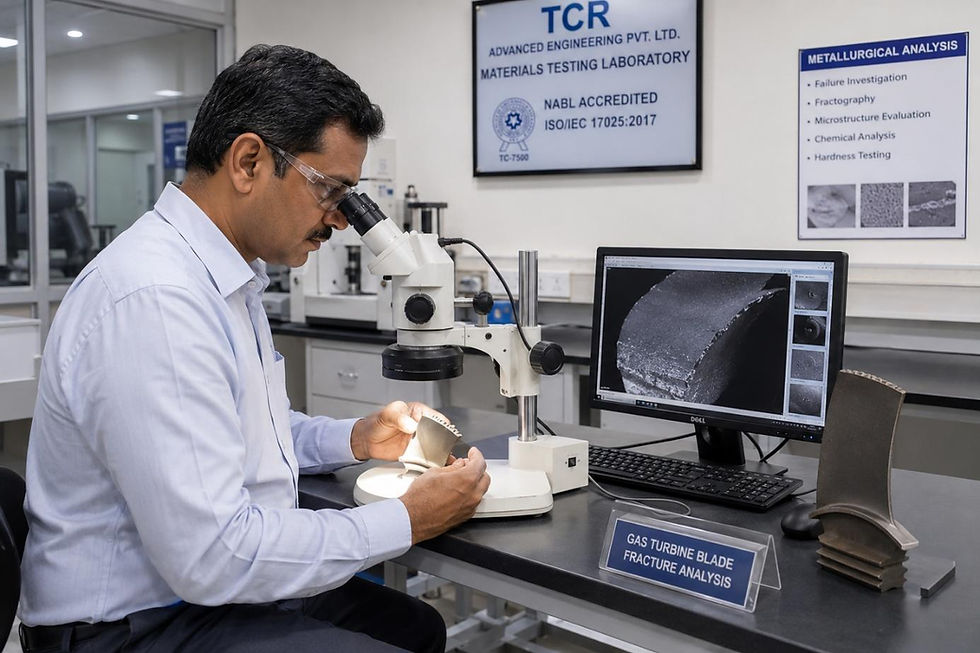
Turbines are the heart of any power plant, converting steam or gas energy into mechanical energy. Their blades rotate at very high speeds and face enormous stresses.
Key causes of turbine blade failure include:
- High-Cycle Fatigue (HCF): Continuous vibrations and cyclic stresses create cracks in the blades, leading to premature fracture.
- Overheating: Poor cooling, hot spots, or improper operation can weaken the blade material, reducing its strength and life.
- Corrosion & Erosion: Steam impurities or corrosive gases can erode the protective surface of blades, gradually thinning the material.
Impact: A single turbine blade failure can cause imbalance, vibration, and even catastrophic damage to the entire turbine. Failure analysis often involves fractography, non-destructive testing, and metallurgical analysis to identify the exact cause.
2. Boiler Tube Ruptures
Boilers in thermal power plants are exposed to extreme temperature and pressure cycles. Boiler tubes are especially prone to failure, making Boiler Tube Failure Investigation one of the most frequently requested services in power plants.
Common causes include:
- Scaling & Deposits: Hard water or improper treatment leads to scale formation inside the tube, acting as an insulator and causing overheating.
- Corrosion: Oxygen corrosion, caustic gouging, and acid attack weaken tube walls over time.
- Overheating: If water circulation is inadequate, localized overheating causes tube swelling and rupture.
- Metallurgical Defects: Issues like improper welding, inclusions, or microstructural weaknesses can accelerate failure.
Impact: A boiler tube rupture can force immediate shutdown, leading to significant power loss and potential safety hazards. Failure investigation typically uses metallography, hardness testing, and chemical analysis to pinpoint root causes.
3. Generator Insulation Breakdown
Generators rely on insulation systems to prevent short circuits and maintain electrical reliability. Over time, insulation deteriorates, especially under thermal and electrical stress.
Primary causes:
- Overheating: Excess load or cooling failure raises winding temperatures, accelerating insulation degradation.
- Partial Discharges: Microscopic electrical discharges damage insulation surfaces, eventually leading to breakdown.
- Contamination & Moisture: Oil leaks, dust, and humidity reduce dielectric strength.
Impact: Insulation breakdown can cause short circuits, unplanned outages, and high repair costs. Preventive measures include insulation resistance testing, PD monitoring, and regular thermal imaging inspections.
4. Transformer Faults
Transformers are vital for power distribution, and their failures can disrupt an entire grid.
Main reasons for transformer failure include:
- Insulation Degradation: Continuous thermal and electrical stress reduces dielectric strength of insulation materials.
- Oil Contamination: Transformer oil acts as both coolant and insulator. Contamination by moisture, sludge, or gas reduces performance.
- Overloading: Excess current load increases winding temperatures, causing premature insulation breakdown.
Impact: A transformer fault not only disrupts power delivery but also poses fire hazards. Failure investigation may involve DGA (Dissolved Gas Analysis), oil quality testing, and electrical diagnostics.
5. Bearing & Lubrication Issues
Bearings support rotating equipment like turbines, pumps, and motors. When they fail, machines grind to a halt.
Typical causes of bearing failure are:
- Misalignment: Incorrect shaft alignment creates uneven loads, increasing stress on bearings.
- Inadequate Lubrication: Wrong lubricant, contamination, or lack of lubrication accelerates wear.
- Fatigue & Wear: Prolonged use without maintenance leads to surface cracks and spalling.
Impact: Bearing issues cause vibration, overheating, and complete equipment stoppage. Failure investigation often uses vibration analysis, oil condition monitoring, and wear particle analysis.
6. Corrosion & Material Fatigue
Corrosion and fatigue are “silent killers” in the power generation industry, gradually weakening equipment until sudden failure occurs.
Types of failures observed include:
- Stress Corrosion Cracking (SCC): Combination of tensile stress and corrosive environment leads to cracking.
- Creep & Fatigue: High temperatures cause slow deformation (creep), while cyclic stresses accelerate fatigue cracks.
- Chemical Corrosion: Exposure to acids, salts, or fuel impurities weakens structural components.
Impact: These failures reduce plant reliability and can remain undetected until a catastrophic event. Advanced failure testing services like SEM/EDS analysis, corrosion testing, and fatigue testing are used to investigate.
Why Failure Investigation is Critical
Each of the above failures can lead to unplanned outages, revenue loss, and safety risks. Failure investigation in the power generation industry provides:
- Root Cause Identification – Prevents recurrence by addressing the exact failure mechanism.
- Predictive Insights – Helps in planning maintenance and replacements before breakdowns occur.
- Cost Savings – Reduces downtime and extends equipment life.
- Enhanced Safety & Compliance – Ensures the plant meets strict industry standards.
These failures can lead to unexpected outages, making failure testing services and investigations critical for continuous operations.
Techniques Used in Failure Investigation
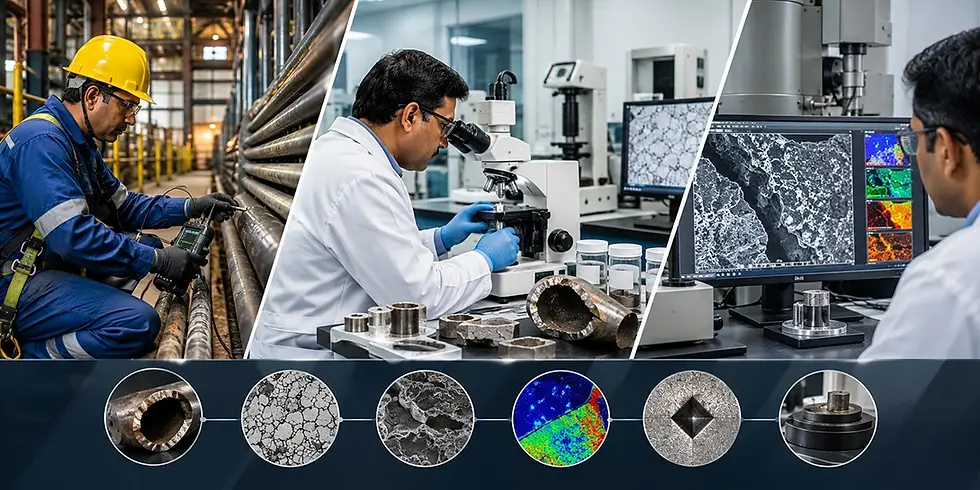
TCR and similar experts employ a combination of analytical, mechanical, and forensic methods to pinpoint the true cause of failure. Key techniques include:
Visual Inspection & Non-Destructive Testing (NDT)
Initial examination using ultrasonic testing, dye penetrant, radiography, and magnetic particle inspection. These help identify cracks, porosity, or structural defects without damaging components.
Metallurgical Analysis & Fractography
Detailed study of the failed component’s microstructure using scanning electron microscopy (SEM), metallographic sectioning, and hardness testing. Fractography provides insights into brittle, ductile, or fatigue fractures.
Vibration & Thermography Analysis
Condition monitoring tools that detect misalignments, bearing issues, or overheating before they escalate into full failures.
Root Cause Failure Analysis (RCFA)
A structured approach combining data collection, laboratory tests, and operational history to determine the exact failure mechanism. This is the essence of Failure and Root Cause Analysis.
Computational Simulations (CFD, FEA)
Finite Element Analysis (FEA) and Computational Fluid Dynamics (CFD) simulate stress, pressure, and flow to validate hypotheses about failure causes.
What Kinds of Samples Do We Test?
During failure testing services, a variety of samples are examined depending on the component and nature of failure:
- Failed Components: Boiler tubes, shafts, reformer tubes, turbine blades.
- Metallographic Specimens: For grain size, case depth, and decarburization studies.
- Corrosion Products & Deposits: To determine chemical attack or scaling.
- Weldments: For weld defects, cracks, and improper fusion.
- Coatings/Platings: To evaluate thickness, uniformity, and failure at the interface.
This comprehensive approach ensures no possible factor behind the failure is overlooked.
Benefits of Failure Investigation in Power Plants
Engaging a specialized partner like the Best Failure Investigation Company in India delivers measurable benefits:
- Reduced Downtime & Improved Reliability: By quickly identifying the root cause, corrective measures are implemented faster.
- Extended Equipment Life: Understanding why failures occur helps optimize maintenance and operating practices.
- Compliance with Safety & Regulatory Standards: Ensures plants meet stringent ASME, ISO, and local environmental norms.
- Cost Savings & Optimized Maintenance: Preventing recurrence of failures saves millions in repairs, replacements, and lost productivity.
For example, a Heater Tube Failure Investigation not only restores the tube but also provides insights into preventing overheating in other sections of the boiler.
Failure Prevention Strategies
Preventing failures is as critical as investigating them. Proven strategies include:
- Proactive Maintenance Planning: Scheduling shutdowns before catastrophic failures occur.
- Condition Monitoring Systems: Real-time vibration and thermography analysis to detect early warning signs.
- Using Advanced Materials & Coatings: Adoption of high-performance alloys and anti-corrosion coatings in reformer tube failure investigation and boiler systems.
- Partnering with Experts for Failure Analysis Services: Collaborating with specialized teams for Shaft Failure Investigation, Heat Exchanger Inspection, and turbine evaluations ensures deep-rooted issues are resolved permanently.
Future of Failure Investigation in Power Generation
The next decade will transform how failures are managed in power plants. Key innovations include:
- AI & IoT in Predictive Maintenance: Real-time data analytics from sensors will predict failures before they happen.
- Digital Twins: Virtual replicas of turbines, boilers, and generators will simulate stress and wear in real time.
- Data-Driven Root Cause Analysis: Machine learning will accelerate Root Cause Analysis, offering solutions backed by massive data sets.
These advancements will complement traditional failure analysis techniques, making power plants safer, smarter, and more efficient.
Conclusion
The power generation industry cannot afford costly downtime or safety incidents. Failure Investigation is not just about repairing broken parts — it is about understanding the why- behind every breakdown. Whether it is a Boiler Tube Failure Investigation, a Shaft Failure Investigation, or a Heat Exchanger Inspection, these analyses deliver actionable insights that prevent recurrence and enhance reliability.
As one of the Best Failure Investigation Companies in India, TCR continues to provide world-class failure testing services and Failure and Root Cause Analysis. By combining deep metallurgical expertise with advanced techniques, they ensure the future of power generation is safe, sustainable, and reliable.
FAQs
Q1. Why is Failure Investigation necessary in power plants?
Failure Investigation helps identify the root cause of breakdowns, preventing recurrence, reducing downtime, and ensuring safe, reliable operations.
Q2. How is Failure Investigation different from routine inspections?
Routine inspections detect visible damage. Failure analysis goes deeper, using metallurgical, chemical, and mechanical tests to uncover the cause- of the damage.
Q3. What types of failures can you investigate?
We specialize in Boiler Tube Failure Investigation, Heater Tube Failure Investigation, Shaft Failure Investigation, Reformer Tube Failure Investigation, turbine, and heat exchanger failures.
Q4. What industries do you serve apart from power generation?
Our expertise spans oil & gas, petrochemicals, aerospace, refineries, heavy engineering, and more.
Q5. How do your reports help prevent future failures?
Our reports provide detailed findings, event summaries, and recommendations for prevention of similar failures — transforming each failure into an opportunity for improvement.


Comments