.png)
Avoiding Boiler Failures and Disasters by Knowledge-Based Audit (KBA)

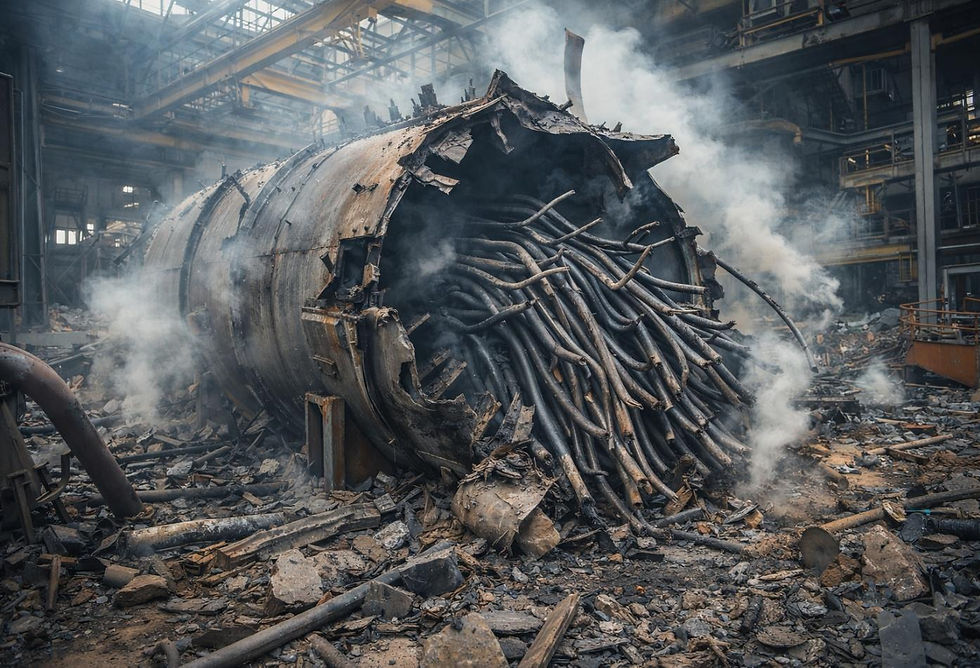
The True Nature of Boiler Disasters
Every experienced boiler engineer has seen the aftermath. The drum ruptured. Fragments travelled as projectiles. The pressure wave demolished the control room wall. Steam at temperatures well above the safe operating range for the tube material filled every adjacent space within seconds. And when the investigation team finally arrived days later, once the site was safe, the first thing they found was a tube wall that had thinned well below its design minimum. That is what undetected wall loss looks like at the end of its road.
Here is the hard truth every plant manager, maintenance head, and asset integrity engineer needs to hear: boiler explosions are almost never accidents. They are the terminal expression of accumulated, undetected damage. The metallurgical fingerprints were written into grain boundaries, oxide layer thickness, tube wall profiles, and water chemistry logs long before the event. They were readable. They were preventable.
The difference between a safe boiler and a catastrophic one is not luck. It is whether someone with the right engineering knowledge audited that boiler at the right interval, using the right framework, and read what it was telling them.
Today’s thermal power stations face a compounding pressure: grid integration of renewable energy means boilers must now ramp up and down far more frequently than their original design envelope intended. Each ramp cycle adds thermal fatigue. Each rapid start-up disturbs water chemistry. Each load swing creates new conditions under which damage mechanisms accelerate and in some cases, activate mechanisms that were dormant under steady-state operation.
The Indian Boiler Regulations (IBR) mandate periodic inspection, and a Knowledge-Based Audit works directly alongside that statutory requirement — it does not replace it. IBR tells you when and that you must inspect. A KBA tells you where to look, with which technique, what you are looking for, and — critically — what process improvements or operational adjustments can arrest active damage before replacement becomes necessary. The two are designed to work together. |

What Steam Temperature Actually Means for Tube Integrity
One of the most common misunderstandings in boiler operations is treating steam temperature as a single number. It is not. The steam temperature you read on the control panel is the bulk fluid temperature. The tube metal temperature the number that actually determines whether creep is occurring is always higher, and in a degraded tube it can be significantly higher. EPRI’s technical reports on boiler tube failures) establish a well-documented principle: internal oxide scale formation, which is a natural and inevitable consequence of steam-steel interaction, insulates the tube wall from the cooling effect of flowing steam. As the scale thickens with service hours, tube metal temperature rises above the design envelope by 14–40°C (25–75°F) even when steam conditions appear normal on every instrument in the control room.
This is why the material grade and its specific design temperature range matter so much, and why a KBA must be calibrated to the actual tube material in service, not to a generic ‘boiler’ assumption. The table below summarises the design and creep-onset temperature ranges for the most common boiler tube grades in the Indian power sector, based on ASM, EPRI, ASME, and National Board guidance:
Material Grade | Typical Application | Design & Creep Temp. Range | Damage Risk & ASM and EPRI Reference Note |
SA-210 Gr.A1/C (Carbon Steel) | Waterwalls, Economisers | Design: up to 450°C (840°F) Creep onset: >425°C (800°F) Graphitisation risk: >425°C on prolonged service | Susceptible to short-term overheating, hydrogen damage, and under-deposit corrosion. Oxide scale growth accelerates above design temperature, raising tube metal temperature by a further 14–40°C (25–75°F) |
SA-213 T11 (1.25Cr-0.5Mo) | Low-temp SH, Primary SH zones | Design: up to 540°C (1000°F) Creep onset: >480°C (900°F) Oxidation limit: ~565°C (1050°F) | Long-term creep and spheroidisation above design range. Premature failure risk from oxide scale insulation effect — tube metal temperature can exceed bulk steam temperature by 25–75°F |
SA-213 T22 (2.25Cr-1Mo) | High-temp SH, Reheaters | Design: up to 565°C (1050°F) Creep onset: >510°C (950°F) EPRI upper limit: 593°C (1100°F) | Most widely used in Indian sub-critical fleet. Vulnerable to Type IV creep at weld HAZ during flexible operation. Fireside corrosion accelerates significantly above 560°C when sulphur/vanadium are present in fuel. |
SA-213 T91 (9Cr-1Mo-V) | Radiant SH/RH, Supercritical | Design: up to 593°C (1100°F) EPRI upper limit: 620°C (1150°F) Oxidation: monitored above 593°C | Advanced grade for supercritical/USC units. Risk of temper embrittlement if PWHT is inadequate. Dissimilar metal weld failure risk at T22/T91 joints — a specific concern during load cycling |
The practical implication is direct: a tube operating within its normal steam temperature range can still be in the creep regime if oxide scale has accumulated sufficiently, if the combustion pattern has shifted, or if soot blower coverage has degraded. A KBA identifies these conditions through oxide scale thickness measurement, in-situ hardness profiling, and direct metallographic evidence of microstructural change — before the tube wall has thinned to a point where inspection findings alone force the decision.
Damage Mechanisms: What Is Actually Happening Inside Your Boiler
Over 9,000 field investigations and more than 2,000 boiler tube failure analyses later, TCR Advanced has documented the same failure modes appearing again and again each with a specific metallurgical signature, each readable with the right techniques, and each directly linked to how the boiler is being operated. The EPRI Field Guide for Boiler Tube Failures catalogues over 50 individual failure mechanisms across water-touched and steam-touched tube systems; the eight most consequential in the Indian flexible-operation context are described below, with their KBA-specific mitigation pathways. Critically, a KBA does not only identify damage that requires tube replacement — it identifies damage that can be arrested by process improvements, operational adjustments, or targeted repair, preserving asset life and deferring capital expenditure.
# | Damage Mechanism | Metallurgical Description, ASM and EPRI Reference | Impact from Flexible Operation & KBA Mitigation Pathway |
01 | Short-Term Overheating | Rapid temperature excursion causing immediate thin-lip fish-mouth rupture. Steam temperature deviates well above the design range for the material in service (see temperature table above). Triggered by waterside blockage, loss of flow, or rapid start-up. | Aggravated by aggressive cold/warm start-up protocols and fast ramp-ups that do not allow adequate tube temperature stabilisation. |
02 | Long-Term Creep | Sustained operation above the material’s creep onset temperature — carbide spheroidisation, grain boundary void formation, wall thinning. EPRI data indicates even a 14–40°C rise above design metal temperature from oxide scale insulation can halve remaining creep life. Accounts for ~30–35% of all boiler tube failures (EPRI/ScienceDirect). | Creep-fatigue interaction during ramp cycles accelerates damage. KBA can identify early-stage creep voids by in-situ metallographic replication and hardness mapping, enabling planned replacement before rupture. |
03 | Waterside Corrosion | Hydrogen damage, caustic gouging, oxygen pitting, and stress corrosion cracking driven by chemistry excursions. A pH deviation outside the 9.0–10.5 target range, or Cl⁻ above 0.5 ppm, can initiate under-deposit attack within weeks. | Poor water chemistry control during frequent start-ups accelerates deposit disturbance. KBA water chemistry analysis identifies deviations; process improvements to dosing and monitoring can arrest the mechanism before tube replacement becomes necessary. |
04 | Fireside Corrosion | Molten V₂O₅/Na₂SO₄ ash attacks outer tube surfaces when metal temperature exceeds approximately 550°C in sulphur/vanadium-bearing fuels. Sulphidation penetrates transgranularly, thinning the wall from outside. | Unstable combustion during load swings concentrates corrodents. KBA fuel analysis and fireside inspection can identify corrosion-prone zones; operational adjustments to air-fuel ratio and soot blower scheduling can reduce attack without tube replacement. |
05 | Fly-Ash Erosion | Abrasive ash impingement in the convection pass progressively reduces tube wall thickness below the code-minimum retirement limit, which varies by tube grade and pressure class but is typically defined in the design documentation and IBR/ASME records. | Erosion accelerates at high loads and with misaligned sootblower nozzles. KBA PAUT survey maps thinning rates; weld build-up repair or shields can extend life where wall loss has not yet reached the retirement threshold. |
06 | Thermal / Corrosion Fatigue | Cyclic thermal stress from load swings combined with a corrosive environment initiates transgranular cracks at weld heat-affected zones. EPRI Field Guide identifies thermal fatigue as a primary waterwall failure mode in units undergoing frequent cycling. | High-frequency load changes significantly increase crack propagation rates. KBA identifies crack initiation by TOFD and PAUT; process recommendations to limit ramp rates within OEM-specified limits can arrest propagation. |
07 | Flow-Accelerated Corrosion (FAC) | Dissolution of the protective magnetite layer driven by reducing water chemistry (low oxygen, low pH) and high flow velocity, peaking in the 130–200°C range. Particularly active in economiser and feedwater pipework. | Load variation and chemistry deviations increase FAC susceptibility. KBA water chemistry review and targeted UT in FAC-susceptible geometries (bends, tees, reducers) identifies at-risk zones; chemistry correction alone can halt progression. |
08 | Dissimilar Metal Weld Failure | Thermal expansion mismatch at ferritic-to-austenitic weld interfaces (e.g. T22 to T91, T22 to stainless) creates cyclic stress concentration. A specific flexibly-operated unit risk. | Enhanced failure risk under cyclic thermal stress during mandatory ramping. KBA identifies DMW locations for targeted inspection; process modifications to reduce thermal shock at start-up are the primary mitigation short of replacement. |
What makes flexible operation particularly dangerous is not that it creates new damage mechanisms it is that it accelerates every existing one simultaneously. A boiler that might have had a safe remaining life of five years under steady-state operation can have that life significantly reduced by aggressive ramping schedules. The only way to know which mechanisms are active, how far they have progressed, and whether the appropriate response is process improvement, targeted repair, or scheduled replacement is to look, with the right instruments, guided by the right knowledge.
What Happens When the Audit Fails
The most consequential line in any boiler accident report is almost never technical. It is almost always operational. “The last audit was conducted four and a half years prior.” Or: “the low-water alarm was acknowledged but not acted upon.” Or: “the safety valve had not been tested since commissioning.”
When tube walls have thinned well below their design minimum and the plant continues to operate with a pressure excursion compounding the stress beyond what the remaining wall can sustain, an inoperative safety valve, and a low-water condition already established the outcome is not a surprise. It is the predictable result of a chain of unaddressed warnings. The explosion destroys equipment, injures or kills personnel, and shuts down production for months.
In TCR Advanced’s experience across more than 2,000 boiler tube failure investigations, the forensic evidence was almost always present and had been for some time: oxide scale measurable by standard UT techniques, waterside pitting visible under low magnification, wall thinning detectable by a routine thickness survey. But none of that was in scope for the last ‘inspection’ because it was a compliance exercise, not an engineering audit designed to find those specific things.
“Most boiler failures don’t happen overnight. They develop through progressive damage mechanisms that leave metallurgical fingerprints. A Knowledge-Based Audit reads those fingerprints and tells you: fix the process, repair the tube, or replace it — before the boiler makes that decision for you.” — Paresh Haribhakti, Managing Director, TCR Advanced Engineering |
The Knowledge-Based Audit: TCR Advanced’s Framework
A Knowledge-Based Audit is not an inspection. It is an engineering process that begins before anyone sets foot in the plant and concludes with a prioritised, actionable programme that distinguishes clearly between three categories of response: process improvements that can arrest active damage mechanisms and extend asset life; repair actions (weld build-up, component replacement) where damage has progressed beyond what operational adjustment alone can address; and planned replacement where remaining life assessment confirms that continued operation beyond the next window would be unsafe. This three-way output is what separates a KBA from a conventional inspection report.
Phase 1: Pre-KBA Study
The process begins online — while the plant is still in operation. Performance data is collected and analysed across steady-state and transient scenarios: cold, warm, and hot start-ups; full-load and part-load operation; ramp-up and ramp-down sequences. Key parameters include main steam pressure, HP and RH steam temperatures, drum level stability, flue gas temperature, O₂ values, and flame scanner intensity. The goal is to understand not just what the boiler is doing today, but the full envelope of thermal stress it has experienced in service.
In parallel, a detailed fuel analysis covers proximate and ultimate analysis, ash composition and fusion temperature, and sulphur/chlorine content. These results directly predict the dominant damage mechanisms: high sulphur content elevates fireside corrosion risk; high ash fusion temperature signals slagging; abrasive ash at high velocity means accelerated erosion in the convection pass. None of this can be assessed by examining the boiler physically — it has to be understood before the inspection programme is designed.
Phase 2: KBA Implementation
Armed with the pre-KBA risk profile, the team deploys targeted advanced NDT to the specific components and locations where damage is most probable. Phased Array Ultrasonic Testing (PAUT), Time of Flight Diffraction (TOFD), in-situ metallographic replication, oxide scale thickness measurement, and Vickers hardness mapping are each directed at the mechanisms the pre-KBA analysis has identified — not uniformly applied across every accessible surface. This is the essential distinction between a KBA and a generic inspection: the knowledge directs the instrument, not the other way around.
Phase | Key Activity | Primary Output |
Pre-KBA | Operational data, fuel analysis, transient scenario mapping (cold/warm/hot start-ups, ramp rates, O₂ profiles) | Risk profile: which damage mechanisms are active or plausible, and at which specific locations |
KBA Implementation | PAUT, TOFD, in-situ metallographic replication, oxide scale thickness, Vickers hardness mapping — deployed to identified risk locations | Quantified damage state: mechanism, severity, location, and estimated progression rate |
Deployment via AiOM® | PoF/CoF matrix, dynamic risk ranking, operational adjustment and process improvement recommendations | Prioritised maintenance programme: repair/replace actions ranked by risk, plus process changes to arrest active mechanisms |
Phase 3: Deployment via AiOM® and Mitigation Recommendations
Findings are integrated into TCR’s proprietary AiOM® (Asset Integrity Optimisation and Management) platform, which generates a dynamic Probability of Failure / Consequence of Failure (PoF/CoF) matrix for each component zone. The output is a prioritised maintenance programme with three explicit streams: operational and process improvement recommendations (optimised ramp rates, water chemistry targets, combustion parameter adjustments, sootblower scheduling) that can arrest active mechanisms without physical intervention; targeted repair scopes for components where damage is advanced but within the repair envelope; and replacement priorities for components where remaining life assessment confirms imminent risk.
This three-stream output is the practical expression of what makes a KBA valuable not every finding requires a tube replacement. In TCR Advanced’s experience, a significant proportion of identified damage can be managed and arrested through process improvement alone, deferring capital expenditure and extending the operating life of serviceable components.
TCR Advanced is approved by the Central Boilers Board (CBB) under the Indian Boiler Regulations (IBR) as a Well-Known RLA Organisation and Material Testing Laboratory — one of the very few firms in India to hold this designation alongside NABL/ISO 17025 accreditation. With over 2,000 boiler tube failure investigations, 300+ RLA projects worldwide, and a proprietary damage-mechanism database built across 9,000+ investigations, TCR Advanced brings a depth of evidence to every KBA that no generic inspection programme can replicate. |
The Technical and Economic Case for KBA
The business case for a Knowledge-Based Audit is straightforward. The cost of a KBA is a fraction of the cost of a single unplanned outage. According to industry data and CEA generation reports, forced shutdowns in large utility boilers result in significant lost generation costs that vary by plant capacity, Power Purchase Agreement terms, and replacement power costs figures that plant operators know precisely for their own units. A catastrophic boiler failure, with structural damage, regulatory penalties, and potential fatalities, is a different order of magnitude entirely.
Beyond risk avoidance, KBA delivers direct economic returns through its three-stream output. Process improvements identified by a KBA can arrest active corrosion or erosion mechanisms eliminating the damage trajectory entirely without capital spend. Targeted repair scopes, informed by accurate remaining life estimates, replace only what needs replacing rather than applying conservative blanket replacement across entire tube banks. And planned replacement, timed to coincide with scheduled outages, eliminates the emergency procurement and expedited work premiums that characterise unplanned failures.
In the context of India’s energy transition, where Power units must now adapt to variable-load grid demands their original design did not anticipate, a KBA is the mechanism by which plant operators can extend asset life with quantified engineering evidence rather than generalised inspection schedules. For plants operated by NTPC, Adani, TATA Power, Reliance Power, and the broader Indian power sector, the KBA is not an audit. It is a strategy for keeping the lights on.
Further Reading
For the complete technical treatment of all damage mechanisms described in this article — including case studies with field photographs and microstructures, material selection guidance, water chemistry interactions, characterisation techniques, and remaining life methodology — readers are referred to the authoritative references below.
REFERENCES & FURTHER READING1. Haribhakti, P., Joshi, P.B. & Kumar, R. (2018). Failure Investigation of Boiler Tubes: A Comprehensive Approach. ASM International. ISBN: 978-1-62708-156-6. 2. Haribhakti, P. & Joshi, P.B. (2021). “Failure of Boilers and Related Equipment.” In: ASM Handbook, Volume 11A: Analysis and Prevention of Component and Equipment Failures. ASM International, pp. 662–694. DOI: 10.31399/asm.hb.v11A.a0006825 3. Haribhakti, P., Chandarana, D. & Patel, G. (2024). “Implementation of Knowledge-Based Audits for Boilers and Associated Piping.” TCR Advanced Engineering Pvt. Ltd., Vadodara. 4. EPRI. Boiler Tube Failures: Theory and Practice (TR-105261), 3 Vols.; EPRI Field Guide for Boiler Tube Failures; EPRI FAC Programme Guidelines. Electric Power Research Institute, Palo Alto, CA. 5. Viswanathan, R. (EPRI). Damage Mechanisms and Life Assessment of High-Temperature Components. ASM International, 1989; and “Materials Technology for Advanced Coal Power Plants,” EPRI, Palo Alto, CA. 6. National Board of Boiler and Pressure Vessel Inspectors. “Microstructural Changes in Steel at Elevated Temperature.” NB Bulletin, nationalboard.org. |
Is your boiler running on knowledge — or on a schedule?TCR Advanced Engineering offers CBB/IBR-approved Knowledge-Based Audits combining the AiOM® platform, in-situ metallography, PAUT/TOFD, oxide scale measurement, and Remaining Life Assessment — with specific process improvement recommendations that can arrest active damage mechanisms before replacement becomes necessary. Serving power plants, refineries, and industrial utilities across India and the Middle East. COMMISSION A KBA | +91 8511179948 | testing@tcradvanced.com | www.tcradvanced.com |
knowledge-Based Audit · Boiler Audit · Asset Integrity · Boiler Tube Failure · Damage Mechanisms · ASM · Remaining Life Assessment · PAUT · AiOM® · IBR/CBB · Power Plant Safety · TCR Advanced


Comments